
A Thousand Shipments a Month
Many waters cannot quench love, the old verse says. A thousand freight invoices a month cannot quench an auditor either — provided the auditor never tires, never errs, and works while the office sleeps.
There is a cost that lands on nearly every imported and exported good and is almost never checked properly: the freight bill. International transportation and its associated charges — the heart of landed cost — arrive as a stream of invoices in several currencies, against tariffs no two carriers share, and someone is meant to verify every one. In practice, almost no one does.
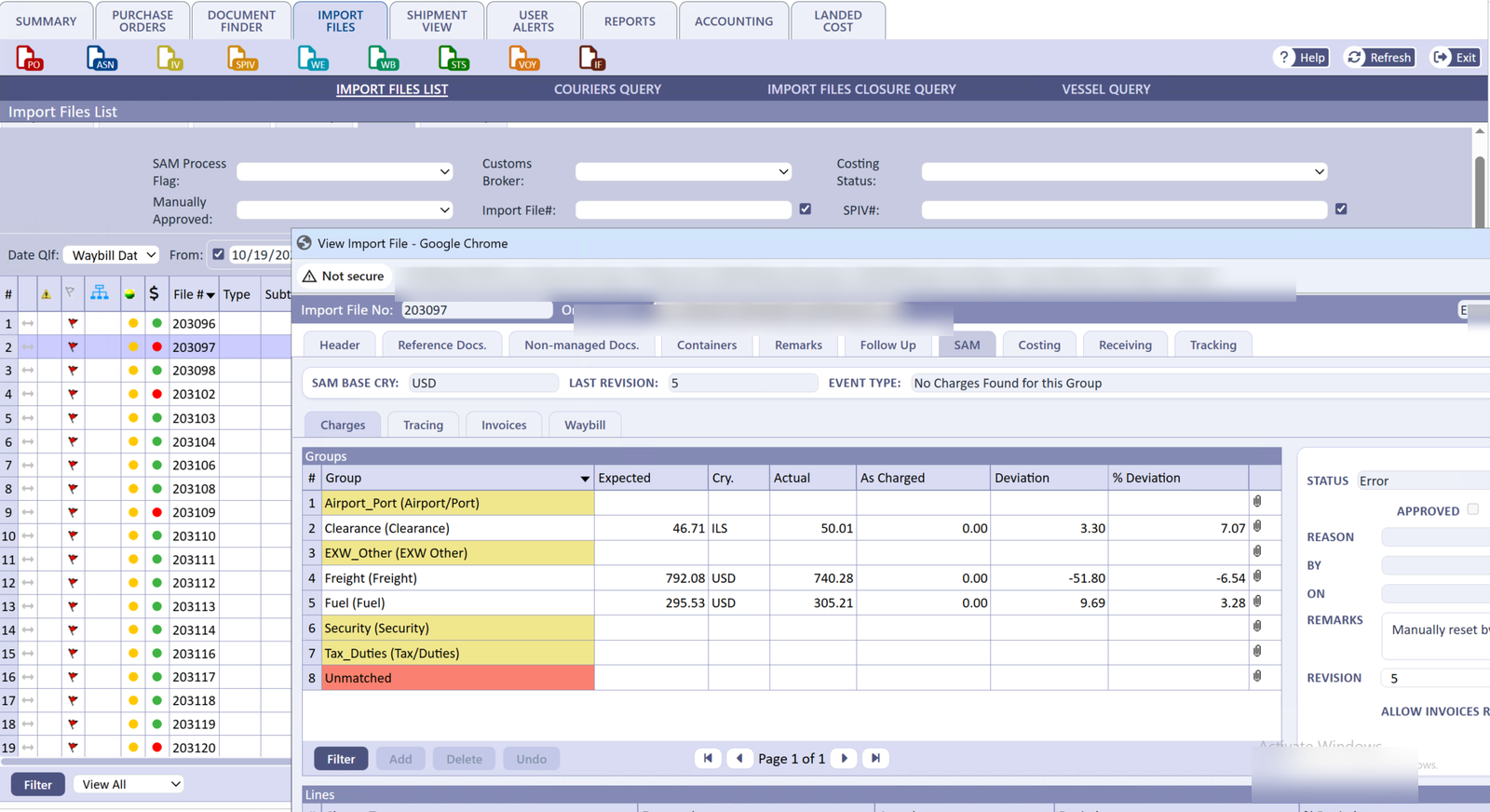
So we built an auditor that does not get tired. SAM — the Smart Freight Audit Module — has run in several large companies since November 2010. In its first year it checked tens of thousands of transportation invoices worth more than $30 million, and it now runs as a service on PERCITE's private cloud. It calculates the expected cost of a shipment to a high degree of accuracy, compares it to what was billed, and flags the deviation — line by line, against shipping prices, tariffs, INCOTerms, exchange rates, bill-of-lading and cargo type, and dozens of other parameters that decide what a freight charge should be.
The accountant’s questionWhat it takes to check one shipment
Picture a single sea shipment: three 20-foot containers and one 40-foot high-cube, sailing Haifa to Marseille, billed by one shipping line and one freight forwarder. The accountant now holds three invoices to verify — against different price lists and tariffs for each carrier, each forwarder, each service and container type, where the charge mixes local-currency fees, ocean cost in dollars, and destination charges in euros. Now add air freight. Now make it 100 such cases a month — then 1,000, import and export together, each shipment drawing two to four invoices plus debits and credits across its life.
Who can cope with that? How much knowledge must sit inside one person's head — and can one person hold it, reliably, over years? The honest answer is no. This is not a failure of diligence; it is a task outside human scale.
Landed cost, measuredThe size of the pain
It is worth seeing what rides on it. Take a mid-size consumer-packaged-goods company exporting at $300M a year and buying much of its raw material abroad:
| Line | Amount | Basis |
|---|---|---|
| Yearly gross revenue | $300M | CPG exporter |
| COGS | $180M | 60% of revenue |
| Material purchased | $90M | 50% of COGS |
| Landed cost — inbound | $1.8M | ~2% of material |
| Landed cost — outbound | $6.0M | ~2% of revenue |
| Total landed cost | $7.8M | 4.33% of COGS |
Call it an $8 million freight-and-logistics budget — a line no standard ERP controls, that only a seasoned logistics professional can truly manage, and those professionals are not common on a manufacturing floor. Eight million dollars, verified by hand or not at all.
Who’s askingFour people, one question
The question looks different depending on who holds it:
The internal auditor — how can these charges be verified at all?
The CFO — how do we post invoices from many different carriers into consistent, fixed accounting lines?
The logistics manager — are these charges right for a shipment split across a customs agent and an ocean carrier? Was there a cheaper way to route it?
The accountant — how do I reconcile three invoices, three currencies and four containers against a different tariff for every party?
SAMA rules engine for freight
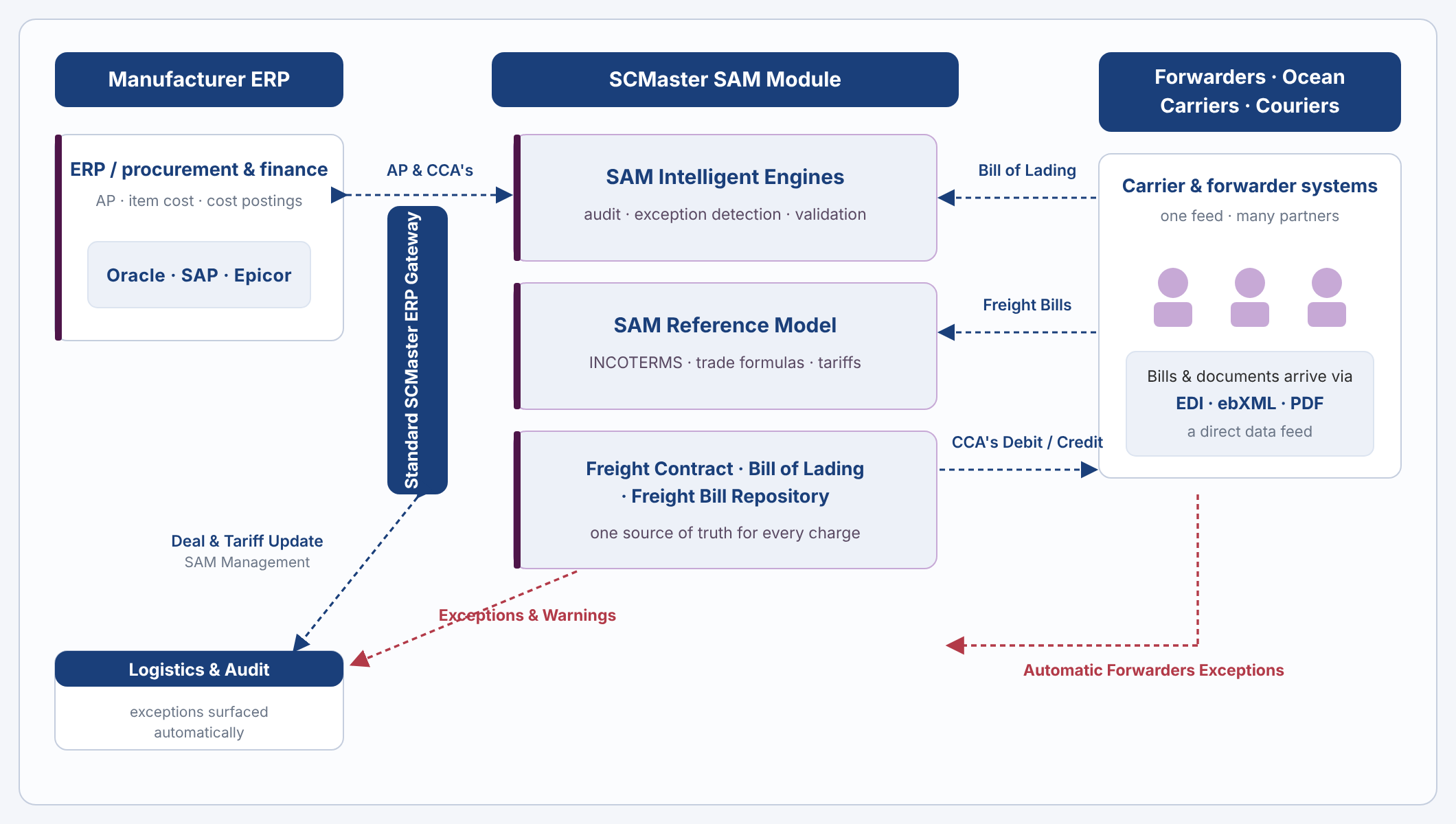
The answer is a product built in layers. An intelligence layer that knows INCOTerms, and the calculation rules of sea and air, import and export — an engine holding dozens of international-trade formulas. A technology layer that takes a direct data feed from the shipping world: invoices and complex shipment data. And a calculation layer that works out the expected cost from that data, against the agreements and tariffs the client maintains in the cloud. The result is control of thousands of charge types, automatically and correctly.
In practice it looks like this — every charge on a shipment, priced as it should be and set beside what was actually billed:
What it’s worthThe values, delivered
- Formal, continuous control of charges across the whole shipment life, against the right tariff
- Alerts on anomalies, against thresholds the client sets
- A deep rules engine, kept current by content experts — not by the customer
- Automatic accounting posting, with data gathered to a statistical base for cumulative analysis and sharper negotiation
- A comparison base for transportation planning — the raw material of price optimisation
No need to blame the accountant any more — a diligent, patient robot does it now.
We will keep the accountant, of course, for the work that still takes human wisdom and judgement. For now.
Many waters cannot quench love.
A thousand shipments a month cannot quench an auditor who never sleeps.