
A World Market for Five Computers
The line long pinned on IBM's Thomas Watson became, through the cloud, ironically close to true. A plain guide to SaaS, IaaS and PaaS — and the questions to ask before you trust your data to someone else's sky.
Everyone is talking about the cloud, and there's a nagging fear that if you don't jump on the train you'll be left at the platform while the rest of the world rolls off to glory. The worry lands hardest on supply-chain managers, who — as we've said before — rarely get the computing and the people they need from their own IT department. Something more urgent is always ahead of them in the queue: production, sales, finance, the next ERP upgrade. Maybe in the mid-year budget review; maybe whatever's left at year-end; well, let's push it to next year.
So this is a technical subject, but the real question underneath is a management one: do you adopt an evolving way of running an organization — one that trades owned infrastructure for flexibility and reach — when you can't get the headcount to build it yourself? Let's crack the term open in plain language, the kind anyone can follow, not just an engineer fresh out of MIT.
The ideaComputing from somewhere else
At bottom, “cloud” means drawing your computing — processing, storage, messaging — from somewhere outside your own machine or local network. The supply is effectively bottomless. In fact the internet itself is already a cloud: type a query into a search engine and the answer arrives without your knowing which servers it crossed. All you brought was the question. Cloud computing simply extends that — not just content, but the processing power itself, living out there instead of on the box under your desk.
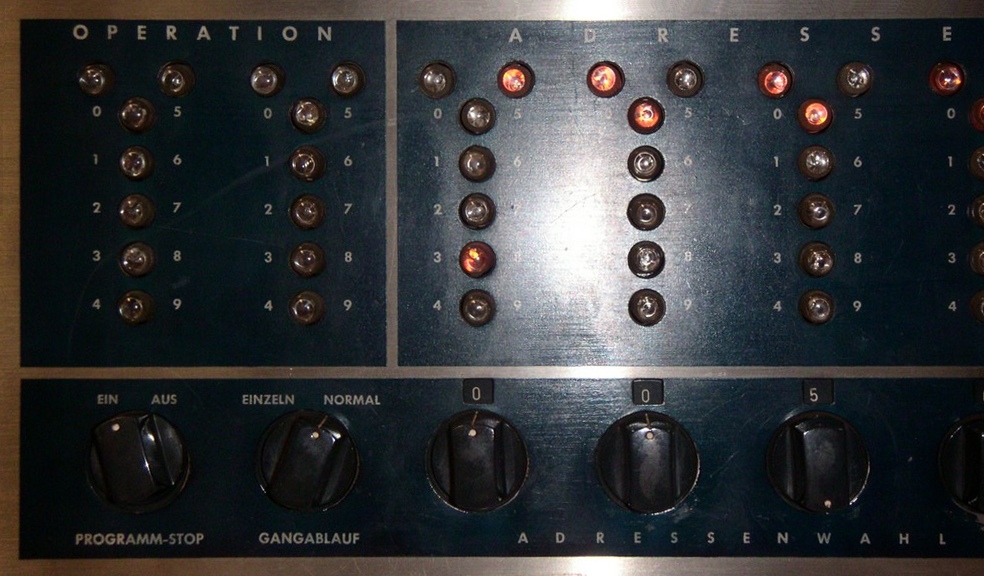
Taken to its logical end, you'd need no computer at all, only a terminal on the network — which is exactly where mainframe computing began, with IBM's 3270 and Digital's VT220 green screens. The wheel comes round. The catch is just as old: cut the connection and you are paralysed, and the security habits of a local world have to be rebuilt for data that now lives on someone else's farm.
In the early 2000s this went by another name — ASP, the application service provider, hosting an organisation's software offsite. Then the walls began to blur. A customer record living in a “cloudy” CRM also needed the balance and payment schedule held in the on-premises ERP — so part of the process sat inside, part outside. That is the hybrid cloud: some data and logic in your own ERP, some in an elastic service that can run 7×24 across ten regions under a service-level agreement no single mid-sized company could afford to match on its own.
The shiftHalf the room is already moving
The corporate computing market was changing beyond recognition, and the sky was filling with IT clouds. Work once sent out was “coming home” — or at least moving closer — and running in cloud form. Around half of companies were already using, or seriously evaluating, cloud in one of its three flavours.
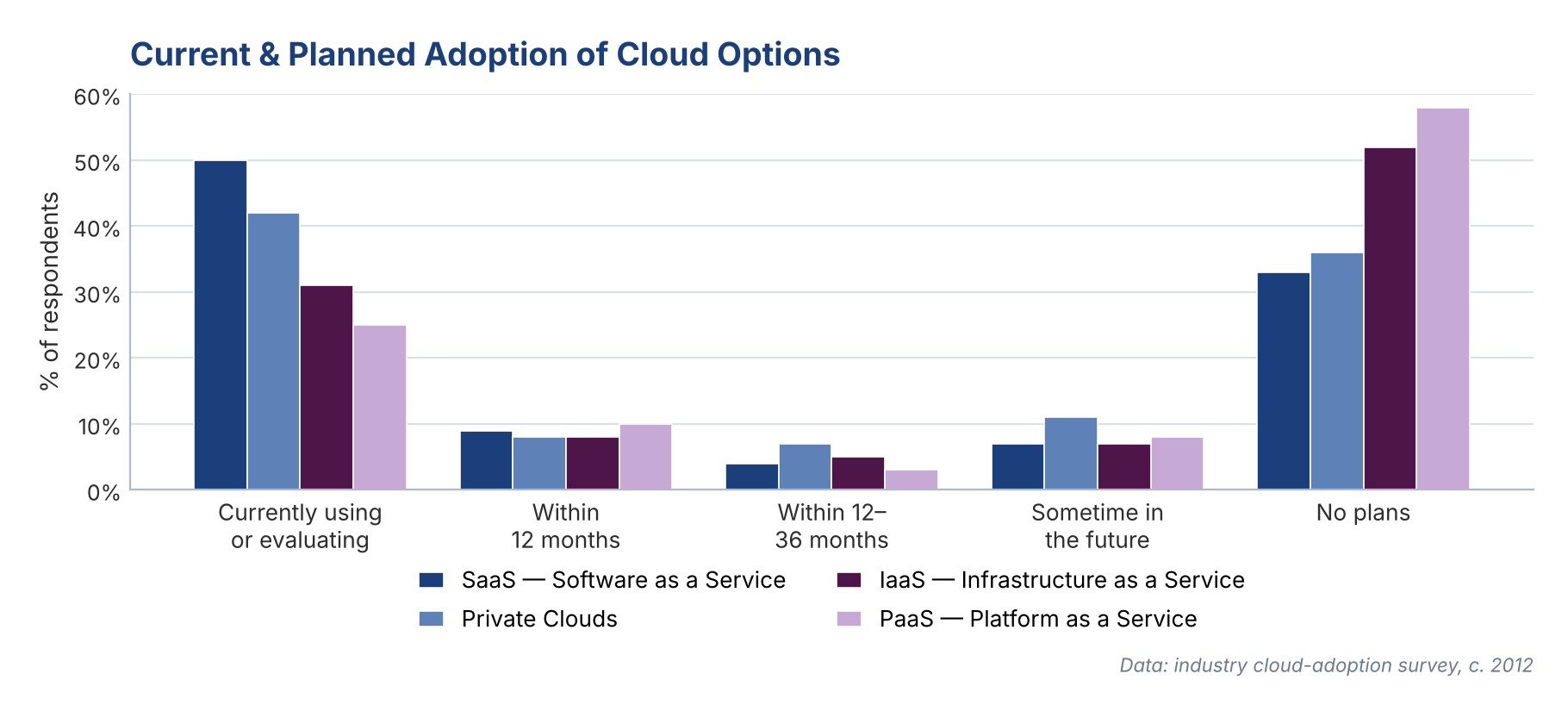
Note the quiet danger in that chart. Cloud grew so attractive that business units began buying services almost without involving IT at all — and IT, so often cast as the department that says no, found itself outside the process it was meant to govern. The real risk was never only infrastructure or manpower. It was the loss of process control: the person accountable for a business process, and for how it ripples into every neighbouring one, no longer holding the reins.
And the forecasts were bold. Gartner expected that by the end of 2016 more than half of the global Fortune 1000 would keep sensitive customer data in a public cloud; a fifth had already started, selectively, in hybrid setups. Under economic pressure, the appetite to cut operating cost and run leaner only grew.
The paradigmAre we breaking the old model?
These weren't light, feather clouds on the breeze. They were cumulonimbus — the heavy, towering kind that make a steady skipper reef the sails — a dense thing full of human experience accumulated since the 1940s. Which raises the real question: were we watching a genuine paradigm shift?

Thomas Kuhn, the philosopher of science, gave us the word. A paradigm is the whole set of agreements, concepts and hard-won beliefs a scientific community commits to — until the anomalies pile up and the model breaks, in a shift carried out not by lone geniuses but by communities. Were we, then, breaking the paradigm forged when computers first embedded themselves in organisations in the 1940s? It had that feel.
The vocabularySaaS, IaaS, PaaS
Every field hides behind three-letter acronyms — IT has GUI, CPU, ERP; we logistics people have FOB, EXW, BAF, CAF. But three cloud terms are worth learning properly:
- SaaS — Software as a Service. You use a vendor's software without buying a licence or owning it — closer to leasing a car than buying one. You pay to operate, not to possess.
- IaaS — Infrastructure as a Service. Not an app but the ground beneath it: virtualisation, elastic compute, communications, backup, disaster recovery, security — consumed on demand. This is a genuine shift in mindset: you outsource the infrastructure itself.
- PaaS — Platform as a Service. The tools and environments developers build on, hosted instead of kept in-house. Mostly a concern for software shops, so we'll set it aside.
Where's the catch in SaaS? The same place it hides in a car lease. Less leaves your pocket in year one — but the vendor is no charity. Price in the interest on the capital you'd have tied up, the depreciation, the maintenance, and across a few years the two models tend to converge; the provider even bakes in a churn-rate premium against the day you leave. SaaS is magic where pay-as-you-go genuinely suits you, but only after you've been honest about your planning horizon.
As for IaaS, think of it as a utility. A hundred thousand years ago our ancestors lit fires in caves, from Europe to the Levant, to make their own local heat. Today power, water and communications arrive over networks, globally, as a service. Why shouldn't computing infrastructure arrive the same way — as a commodity you simply draw on? The internet is the proof it already does.
Before you trust the skyThe questions to ask
Someone has to be first into the water; others are wise fast followers, learning from the pioneers' mistakes; and some just wave their arms and list reasons why not. A clear global trend is no licence to walk forward with your eyes shut. So when a product arrives “in the cloud” — installed somewhere you can't see — ask:
- Security. Who can reach your application and your data? Are your tables private, or shared with other tenants in a multi-tenant setup? Is there encryption, a firewall, a private virtual network?
- The provider's track record. Real depth in virtualisation, storage, backup and disaster recovery — and true elasticity, the ability to add power, bandwidth or years of retention quickly as you grow.
- Service level. Availability, backup frequency, failover to an alternate site, recovery time, patch and upgrade cadence, regulatory support — and the ability to monitor your own usage.
- The exit. This is the one people forget. What is the disconnection policy? Can you get your data back, in full, with its dictionary — and who owns it? You can walk away; so can they. Plan for the day the provider leaves.
A clear trend is no licence to walk forward with your eyes shut. Understand the needs, the limits, and the exit — then decide.
The prophetsOnly five computers
Predicting this industry has humbled better minds than ours. The line most often quoted — “I think there is a world market for maybe five computers” — is pinned on IBM's Thomas Watson in 1943 (historians doubt he ever said it, but never mind). Digital's Ken Olsen, who built the machines that democratised computing, genuinely scoffed in 1977 that there was “no reason for any individual to have a computer in his home.” Each looks absurd beside a teenager who now carries an iPad, an iPhone, a laptop and half a dozen IP addresses before breakfast.
And yet. In 2010 Yahoo's research chief Prabhakar Raghavan observed that “in a sense there are only five computers in the world — Google, Yahoo, Microsoft, IBM and Amazon,” the few able to turn electricity into computing at that scale. Clay Shirky added that the web was becoming one giant programmable machine — Watson had merely overcounted by four. The wrong prophecy came, through the cloud, eerily close to right.
But the one who saw furthest was Isaac Asimov. Back in 1956, in a short story called “The Last Question,” he imagined a single global computer — Multivac, growing over aeons into a cosmic intelligence spanning space itself — asked again and again whether entropy could be reversed, and answering, each time, across billions of years: there is as yet insufficient data for a meaningful answer. The stars burn out. Matter, energy, space and time run down. And when at last, in a dead and empty cosmos, the machine finally knows the answer, there is no one left to tell —
“And AC said, Let there be light. And there was light.”
— Isaac Asimov, “The Last Question,” 1956
With thanks to the two colleagues whose two years of cloud research and field projects this piece draws on — their work is the ground it stands on, and their names we keep, with gratitude, on file.