
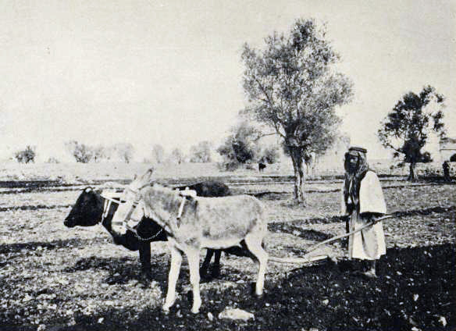
Lift Your Eyes to the Field
The operator spends the day head-down in one furrow — this shipment, this supplier, today's schedule. To manage a supply chain you have to straighten up and measure the whole field. On SCOR, the handful of KPIs that matter, and the one that rules them all.
The people who actually run a supply chain — in procurement, operations, logistics, finance, sales, the plant — spend their days ploughing furrows. Head down, pushing through resistant soil and stubborn obstacles to get this shipment out, settle that supplier dispute, hit today's build. It is honest, necessary work, and it is also the whole problem: a furrow at a time, you can never see the field.
Management means lifting your eyes: seeing the entire chain that serves the business — demand triggering procurement, development and manufacturing, logistics and customs, raw materials and finished goods, delivery to the customer, and finally the cash coming back and the profit landing. The things that decide whether that chain is any good are rarely visible on the surface — “what is essential is invisible to the eye,” as the fox tells the Little Prince. You have to go down into the detail to see them at all, and then you have to measure. But measure what?
The frameworkWhy you need structure before data
Begin collecting data first and you drown. Without a structure, the engineering conversation never starts: you can't say which numbers matter, where to find them, or what “good” looks like. So start from an established frame. The best known is SCOR — the Supply Chain Operations Reference model — built in 1996 by the consultancy PRTM and stewarded for years by the Supply Chain Council. Even where you must adapt it, it keeps you from gathering data aimlessly.
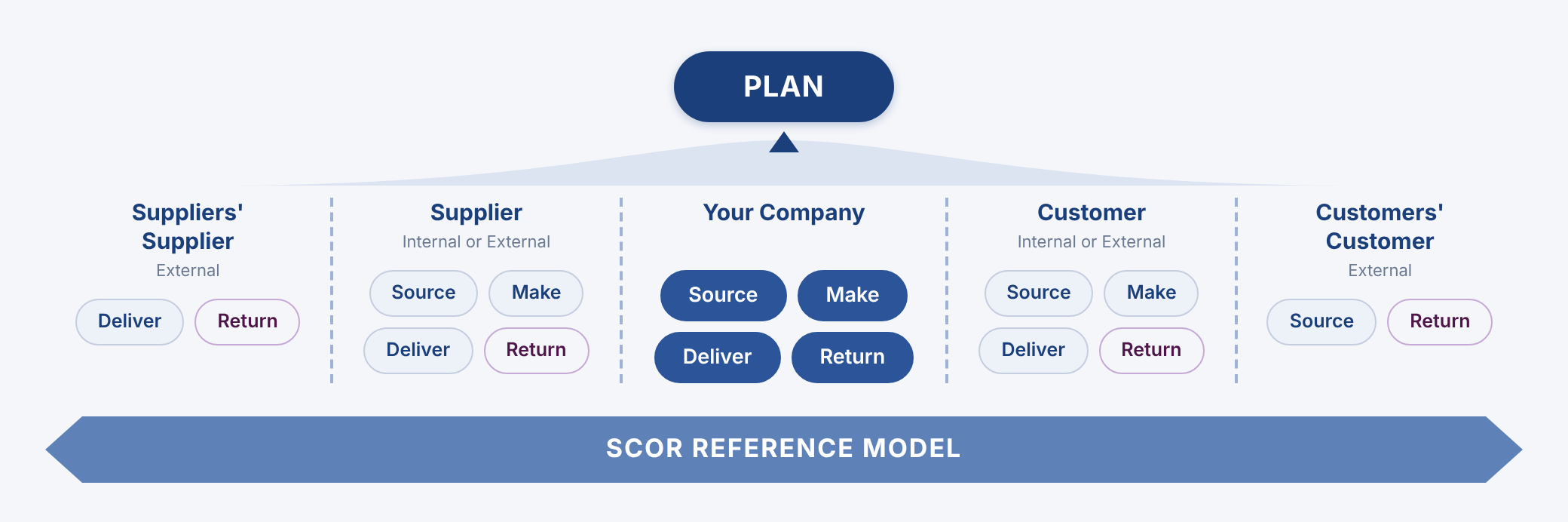
Five processes cover everything: Plan optimises the flow; Source, Make and Deliver are the execution that creates value and revenue; Return handles the defective goods coming back from customers and going back to suppliers. For each one, SCOR asks you to look across several dimensions — metrics, business rules, best practices, inputs and outputs, people, geography, and technology. That last word carries weight. Reading real performance out of a flood of operational events is not a “show me shipment status” query; it needs a platform built for analysis.
And one metric sits above the rest: cash-to-cash cycle time — the days between spending cash on inventory and collecting it back from the customer. It quietly captures the efficiency of the entire chain. It is also devilish to compute: when, exactly, did that inventory become yours, if you bought it ex-works in Canberra and it spent six weeks on the ocean? Miss the moment stock enters your possession and even this fundamental number slips out of reach.
The disciplineStart with the goal, never the data
Here is the mistake almost everyone makes, so it's worth saying plainly:
Do not start with the data. Start with the goal — then find the metric, then the data.
Begin with data and you get paralysis dressed as analysis: mountains of incomparable series and no decision at the end. The right order is the reverse — define the objective, find the areas that serve it, choose the metrics that measure those areas, and only then build the collection. Which areas even matter depends entirely on what the organisation is trying to do. There are three useful lenses, and you may need more than one at once:
- Process-driven — planning accuracy against real demand, supplier and inventory cycles, delivery and documentation quality, how fully you're using a container or a truck.
- Functional — material cost as a share of sales, inventory turns, scrap and rework, order-to-cash duration, billing accuracy, returns.
- QCDF — the cross-cutting four: Quality, Cost, Delivery, Flexibility. Whatever the method, the data has to be collected one formal, unified way — or you'll just make mountains of numbers that can't be compared.
Tie every metric to a real objective — cut supply-chain cost, lift revenue and margin, sharpen manufacturing, free up working capital. The leverage is bigger than it looks: trim 3% from a cost that is 70% of the product, and annual gross profit can move 1–5%.
The metrics that matterStrategic, then diagnostic
Not everything measurable deserves measuring. SCOR sorts metrics into tiers: strategic KPIs that move financial results (these are the ROI enablers of an earlier piece), diagnostic metrics that locate where a problem lives, and general metrics that merely add visibility. The strategic set is short, and it is organised by what each one tells you about the chain:
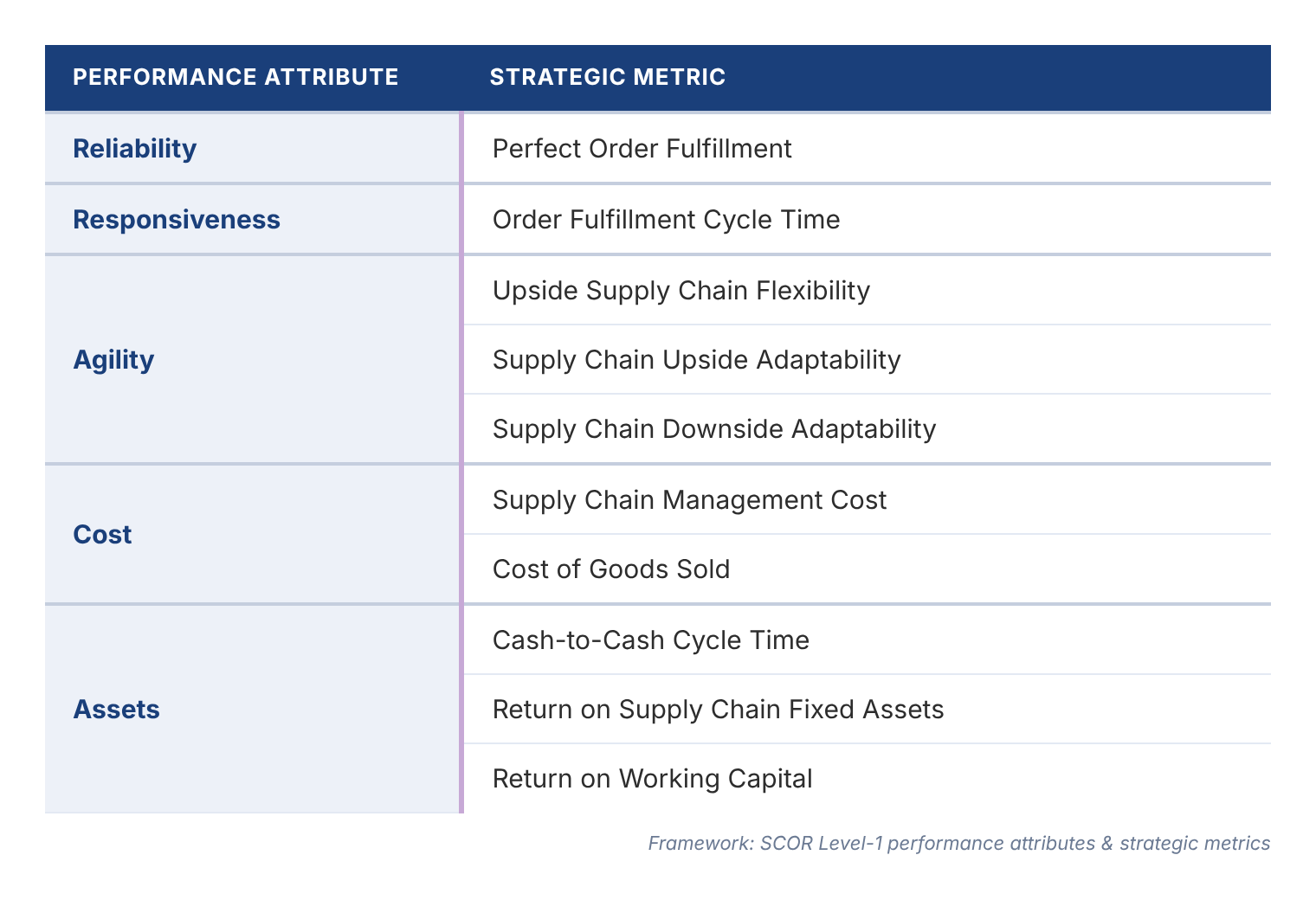
Each KPI sits on a mass of data — some pulled automatically from the ERP or a supply-chain system like SCMaster, some gathered by hand. And every strategic number rests on the diagnostic ones beneath it: the second tier is where improvement actually happens.
A worked exampleSixty-four days, segment by segment
Take one diagnostic metric — the duration of an international move, read not as a single number but segment by segment. Here is an ocean import from Australia to Israel, each leg shown as planned against actual:

Two things fall out of that one small table. First, plan versus actual: knowing the real elapsed time, leg by leg, lets you plan material against supplier promises and build schedules with far more honesty. Second, granularity: at segment resolution you can grade the logistics providers themselves. Add cost and service-quality to the view and you can compare carriers, fix the weak legs, and drive down transport spend — feeding the two hardest-nosed attributes in the table above, Cost and Assets, and with them cash flow and working capital.
That is the whole arc, from furrow to field: the daily work gets the shipment out, but it is the lifted gaze — the frame, the short list of metrics, the diagnostics beneath them — that turns firefighting into engineering, and engineering into advantage.
What you can measure, you can improve.
But first you have to lift your eyes to the whole field.
With thanks to the operations, logistics and finance managers — whose names we keep, gratefully, on file — who plough these furrows daily, and who pushed us to frame and measure the whole of them.