
Necessary, But Not Sufficient
EDI gives trading partners a shared machine language. But a common vocabulary was never the hard part — agreeing on the play was. Why so many projects crashed, and what finally made them work.
We live in a century so astonishing that a traveller in a blue-painted hill town in Rajasthan can pull Hubble's images of impossibly ancient galaxies out of a phone. And yet two trading computers — one at a car-parts buyer, one at a supplier's warehouse in Frankfurt — still struggle to agree, reliably, that this invoice belongs to that order. That small, stubborn gap is the whole story of EDI.

The standardsA common tongue
EDI — Electronic Data Interchange — is simply machines exchanging business data without a person re-typing it. For that to work, both sides need a standard. Two emerged and endured: ANSI X12, born in the United States in the 1970s, and UN/EDIFACT — EDI for Administration, Commerce and Transport — the UN/ISO standard that followed in the 1980s and 90s, with thousands of concepts, fields and attributes. The reason the rigour matters is painfully concrete: a ship's manifest that declares 1,000 CEU (car-equivalent units) must never be read by the port as 1,000 TEU (twenty-foot containers). One letter — C for T — and the yard, the cranes and the storage plan are all wrong.
Why projects crashedNecessary, but not sufficient
Here is the lesson that cost the industry dearly. A shared language is necessary — but it is not sufficient. Through the 1990s, hundreds of EDI projects crashed on these rocks, leaving millions of dollars and a lasting distrust of the whole field. Why? Because the fact that two systems can exchange a document does not mean they agree on the business process behind it. You would not want to receive an invoice for an order you never placed — or for one that changed in transit when your production plan moved. Compatible technology is table stakes; what was missing was a stable data repository and a genuinely shared, inter-organisational process.
A common language is necessary. Agreeing on the play is what's hard.
The formal processScenarios and episodes
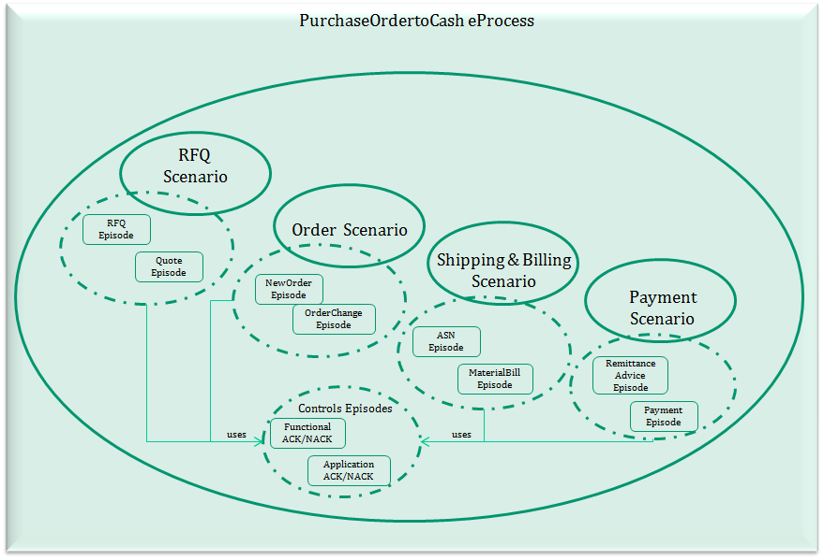
The method that works borrows, of all places, from the theatre. Map the whole exchange formally, as a play: break it into scenarios — sub-processes, like ordering — and each scenario into episodes: issue a new order, approve it, accept or reject a line, change it. Each episode has defined inputs, logic and agreed outputs. Only then zoom in on the role-players and pin down the rest: which transmissions pass between partners (purchase order, supplier invoice, packing details), their timing, and the functional acknowledgement — ANSI's 997, EDIFACT's ACK/NACK — by which each side signals received, and in order — or not.
ControlAutomatic judgment
With the play agreed, one decision remains: what to control automatically, and what to escalate to a human. Because the documents still arrive imperfect — an invoice with a VAT amount but no rate, a charge with no code, a bill of lading that references a waybill the system can't find. A rules-driven control layer catches these the moment they land, before anyone pays:
| Invoice / date | Partner | Flag |
|---|---|---|
| …685 · 17 Dec | Carrier A | Related waybill / file not found |
| …868 · 23 Dec | Carrier A | VAT amount present, but rate missing |
| …888 · 23 Dec | Carrier A | Charge code missing |
| …968 · 25 Dec | Carrier A | Charge code missing |
This is the point of it all. Humans were not made to type data from morning to evening — data a machine can capture — but they are needed to judge that you cannot pay for a service not yet received, or post a charge that maps to no account. The system does the typing; the rules do the first judging; the person handles only what truly needs them.
And when it all comes together, one small event does extraordinary work. A bill-of-lading transmission for a vessel bound for Haifa tells the tracker the goods are near; it reasons they'll clear in two days (customs is closed Saturday); it shifts the expected receipt date of the import line that arrived earlier on the supplier's invoice; it posts the inventory value to the books; it warns the warehouse to make room for twenty containers; and it ties a security-tracked serial number to the very container it is packed in. So you can ask —
“Where is item ZZ-XE-008, serial 001-09?” — and be told: in customs release, Haifa.
Sounds crazy? It isn't.
With thanks to the logistics and IT teams — at carriers, forwarders and importers whose names we keep, gratefully, on file — who helped turn an esoteric standard into a working process.