
One Letter, Two Hundred Thousand Dollars
Export is the eye of the storm: supply a shipment on time — not early, not late — and within budget. Then discover that a single wrong letter on a bill of lading can cost you a quarter's revenue.
Picture the bill of lading that reads CARONOUTICS where it should have read CARONOUTIX. One stray letter. It no longer matches the letter of credit, so the bank wants €200 to amend it — the part you could live with. What you cannot live with: the shipment arrives a week late, the QA and engineering team sits idle at the customer site, and the milestone that would have recognised $200,000 of revenue slips past the quarter's end. One letter.
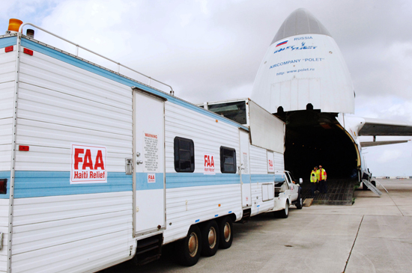
Contrast the day the same team loaded a satellite onto a Russian Antonov super-freighter and cleared customs without a hitch, hitting the launch window — an Antonov that costs $100,000 a day to sit, a miss that would have run to millions. When export goes right, nobody thanks you. When it goes wrong by one character, it is catastrophic. That asymmetry is the job.
The eye of the stormPlanning before there’s an order
The strangest part is that the hardest planning happens before the ERP knows anything. Who has space for forty 40-foot containers to Houston this week — while there is no Sales Order yet, let alone a Delivery? How do you cost-plan across two shippers, three couriers, four shipping lines and six airlines — in a spreadsheet? Where is the spot quote a colleague got for the same lane a month ago — buried in his Outlook? And all of it threaded through export licences, the sacred 6:1 air ratio, customs invoices in currencies the ERP refuses to hold, serial-level traceability, and the small matter of teaching the system that a carrier event called On Board on one website and Departed Origin on another are the same moment — the moment revenue may be recognised, depending on the INCO point your ERP has probably never heard of.
By 2012 the scale behind all this was striking in its own right: national exports had grown from roughly $6 million in 1948 to about $94 billion in 2011 — per-capita exports from $7 to some $11,500 (Export Institute and Central Bureau of Statistics figures, reported by YNET, 2012). Goods volume rising ~6% a year, and every parcel of it needing to cross a border on time.
SETUPA babel of codes
Before any of it works, the data has to be set up — and the ERP, implemented by people who know finance rather than freight, usually isn't ready. Take one question: how is Haifa coded in a customer's ship-to location — Haifa, HFA, or ILHFA? The honest answer is it depends — on the Mode of Transportation. By ISO, the city is ILHFA for sea and land; fly the cargo in and IATA wants HFA for the airport. Get it wrong and the bill of lading is wrong. (There are, by the way, more than thirty towns named Washington in the United States, each with its own code. You want Washington, Iowa — not, again, Washington, Indiana.)
EsperantoA neutral language for freight
Shippers, airlines and couriers each speak their own dialect of codes and tariffs. The breakthrough is to make them all speak one — the way Zamenhof built Esperanto as a neutral tongue to bring speakers of different languages closer. Build the tariff infrastructure in a single neutral language, with one comparison unit — a kilo, a ton — from source port to destination, and you can finally ask the question that used to take three phone calls and a merged spreadsheet: who moves 1,200 lb from Haifa to Washington, at what price, on what schedule, at what service level?
BreakPointThe devil in the details
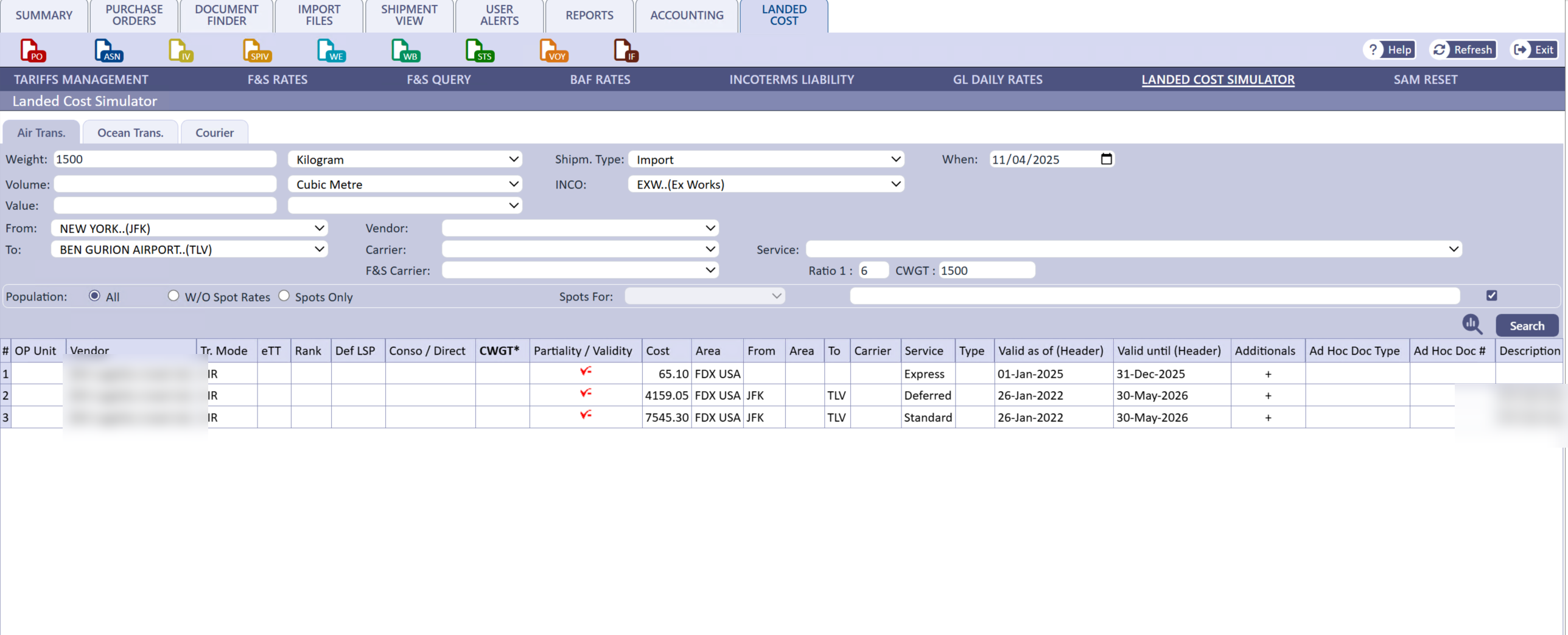
Then the detail that no one has time for. The system reads weight and volume from the ERP, sees the shipment is air and EXW, applies the right volumetric ratio — 1:6 for air, 1:1 for sea, 1:5 for certain couriers, all parameters — and works out the chargeable weight. For 0.4 cubic metres that is 66.67 kg; but the system recommends pricing at the 100 kg break-point, because past that line the rate drops and you pay less for more. Save 5% there, 2% by picking the better of two carriers, and that is 7% on a single shipment — across hundreds of shipments a year. Who could reach that calculation by hand, with no time for anything?
OperationsTwenty-four miserable hours
And then it has to actually ship. The desk is under genuine pressure: what did the warehouse really pack, where is it really going, how do we consolidate as much as possible for one customer and ship-to — provided it's the same INCO, not no-charge mixed with charge, and the same export licence? Which documents, to whom? A price quote required above 1,000 kg from two shippers whose reps sit in the same room and may not see each other's rates. Ten parcels made the flight and two were left behind for security — cue another email. These are, as the saying went, twenty-four miserable hours in an export person's life.
SCMasterThe wisdom of action
So how do you hold operational simplicity and a mutable rule-set together — with the override a human will always need, because no system matches good improvisation? The smallest unit is the ERP Delivery: packed items, sales lines, weight, volume, project, business unit. It flows to SCMaster on creation, is translated into a standard data dictionary, and at a click a batch of deliveries is proposed for one consolidated dispatch. The system pauses where a human must decide — weight over a threshold raises a price-quote task through the workflow engine — then generates the documents from the base data, with room to adjust. And quietly, behind all of it, a logistics database builds itself: multi-company, multi-currency, reconciled against what accounting actually posted — so the question that used to be unanswerable becomes a click:
- “What did we pay from the Philippines to São Paulo, UPS versus DHL — and where were the anomalies?”
- Transportation in euros and dollars at once · sea, air and courier combined · every figure reconciled to the AP posting of its day.
In its full shape SCMaster is a pyramid of four areas: two that run the logistics — procure-to-pay and order-to-cash — and two that make the CFO comfortable. SCM Audit controls charges, documents and shipping parameters against ERP data. The BI Gateway exposes logistics and financial control in real time — so when a carrier reports On Board, the system is sure enough to let the quarter recognise the revenue.
You have the knowhow — we are just the platform.
“Would you tell me, please, which way I ought to go from here?”
“That depends a good deal on where you want to get to,” said the Cat.
“I don't much care where —” said Alice.
“Then it doesn't matter which way you go,” said the Cat.
— Lewis Carroll, Alice's Adventures in Wonderland
If you don't know where you want to arrive, any road will take you there.
Export is the discipline of knowing — exactly, to the letter.
With thanks to the procurement, logistics and supply-chain teams who taught me this craft — at electronics and telecom manufacturers, a defence-systems house, and a pharmaceutical group — whose names we keep, gratefully, on file.