
Packed Like a Pomegranate
The world of import is packed tight with seeds — carriers, brokers, permits, classifications, multi-currency invoices — and it is growing faster than any team can be staffed to hold it.
Cut open the world of import and it spills out like a pomegranate — seed upon seed, packed tight: tasks and coordinating parties, government bodies and permits, shippers and airlines and shipping lines, customs brokers and classifications, standards approvals, tariffs, supplier invoices and import records, and a body of esoteric knowledge held by a handful of experts. No two importers face the same version of it. A telecom-component importer looks nothing like a raw-materials importer, and neither resembles a pharmaceutical house or a steel importer supplying defence projects — where licensing, controls and batch tracking are the whole game.
Model the problem down to its parts and a handful of scenarios recur, each its own discipline:
- Import planning — guiding procurement on trade terms (INCOTerms) and the freight price that follows from the cargo's nature, urgency and sensitivity
- Coordinating carriers with suppliers — and re-coordinating them every time an order detail changes
- Release documents — classification, permits and import licences
- Physical pickup — controlling the move from the port of origin, and keeping production and sales honestly informed of arrival (ETA)
- Release, tax and VAT — handling the funds and the clearance
- Onward distribution — from destination port to the plant or the warehouse
- Cost and documentation — every charge captured, every event recorded, freight, duty and VAT posted cleanly and on time
- Analysis — reading logistics cost and performance to improve the whole cycle
The numbersGrowth outruns the hands
And the volume only rises. The forecasts of the day, around 2012, told a plain story: national goods imports climbing from roughly $33 billion in 2002 toward $75 billion by 2015, per-capita imports nearly doubling over the same span — all of it compounding at some 7% a year.
- $33B → ~$75B — national goods imports, 2002 to 2015
- $4,952 → ~$9,005 — imports per capita, same span
- ~$1.5 billion a year — freight to verify on imports alone. Who has the strength to check it by hand?
Consumption rises faster than the workforce that must manage it — the orders, the invoices, the filing, the updates and the controls. An organisation at $50 million in sales and up, running an orderly ERP and moving a thousand import transactions a year or more, cannot meet this with more hands. It has to organise differently.
Deep domainsThe remedy — two decades, distilled
The answer did not arrive in a sprint. It crystallised over two decades, out of several deep professional domains that most software never touches: years of practice in shipping and customs brokerage; years building EDI flows across invoicing, procurement and international freight; years inside procurement across different ERPs; and real depth in multi-currency, international accounting. A freight system written without those disciplines is a guess. This one is not.
SCMaster SphereThe import module
The import module — a cornerstone of the SCMaster platform — holds the process from the moment a purchase order is raised until the goods are received into the warehouse, managing the import file throughout. It serves the three parties who rarely share a view: procurement, logistics, and finance. And it does the hard things as a matter of course:
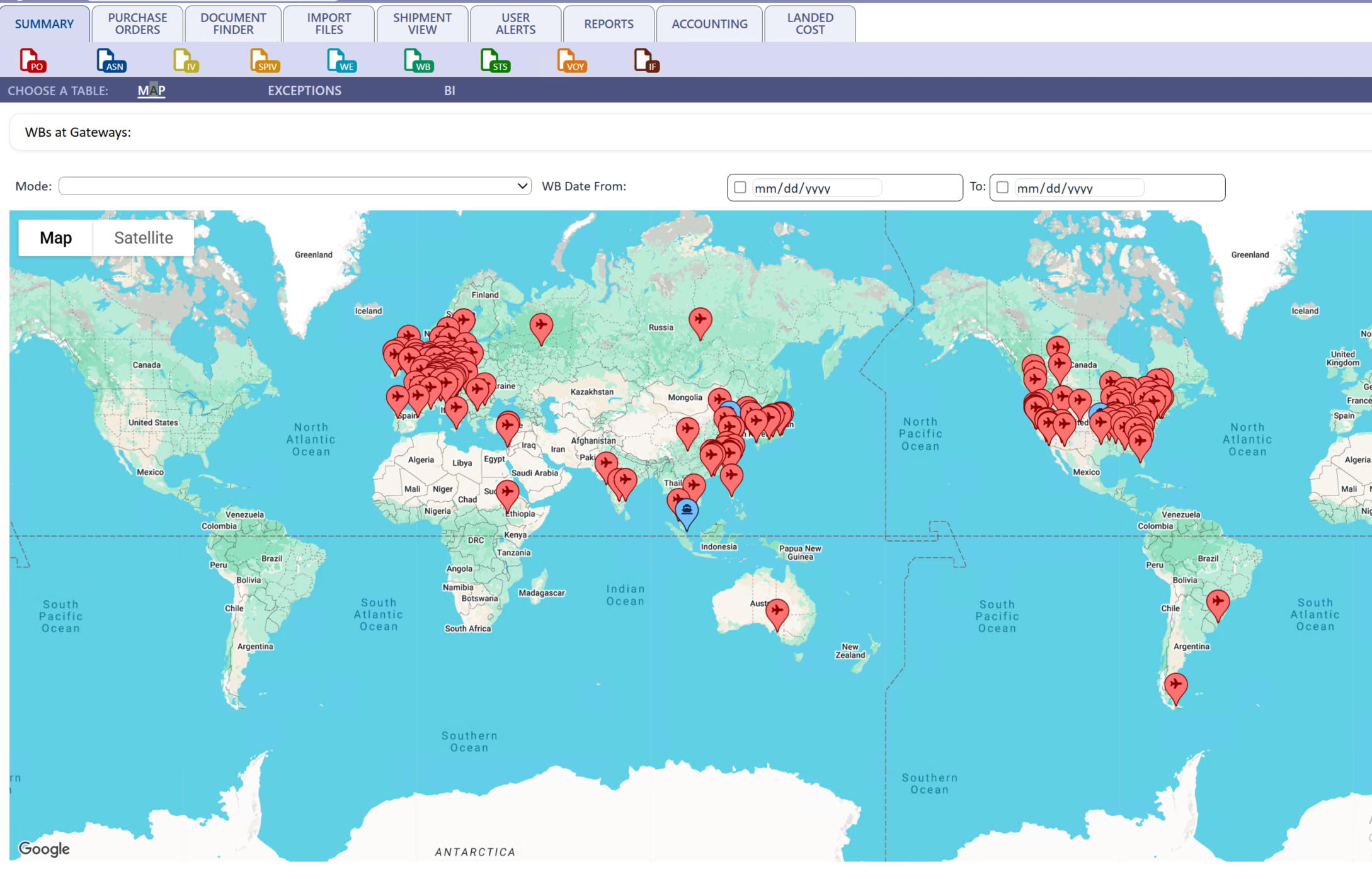
- Inventory in motion, made visible worldwide — locate any item by order, SKU, or trade document, anywhere in its journey
- Electronic documents and events exchanged directly with suppliers and carriers
- A live connection to the ERP — orders, inventory and finance updated straight from the trade documents, without re-keying
- Milestone alerts — standard times and business rules per step, so a deviation recalculates the timeline and raises a flag
- A dynamic trade-document repository — orders, invoices, confirmations, bills of lading, freight and service charges, customs records — queryable in real time
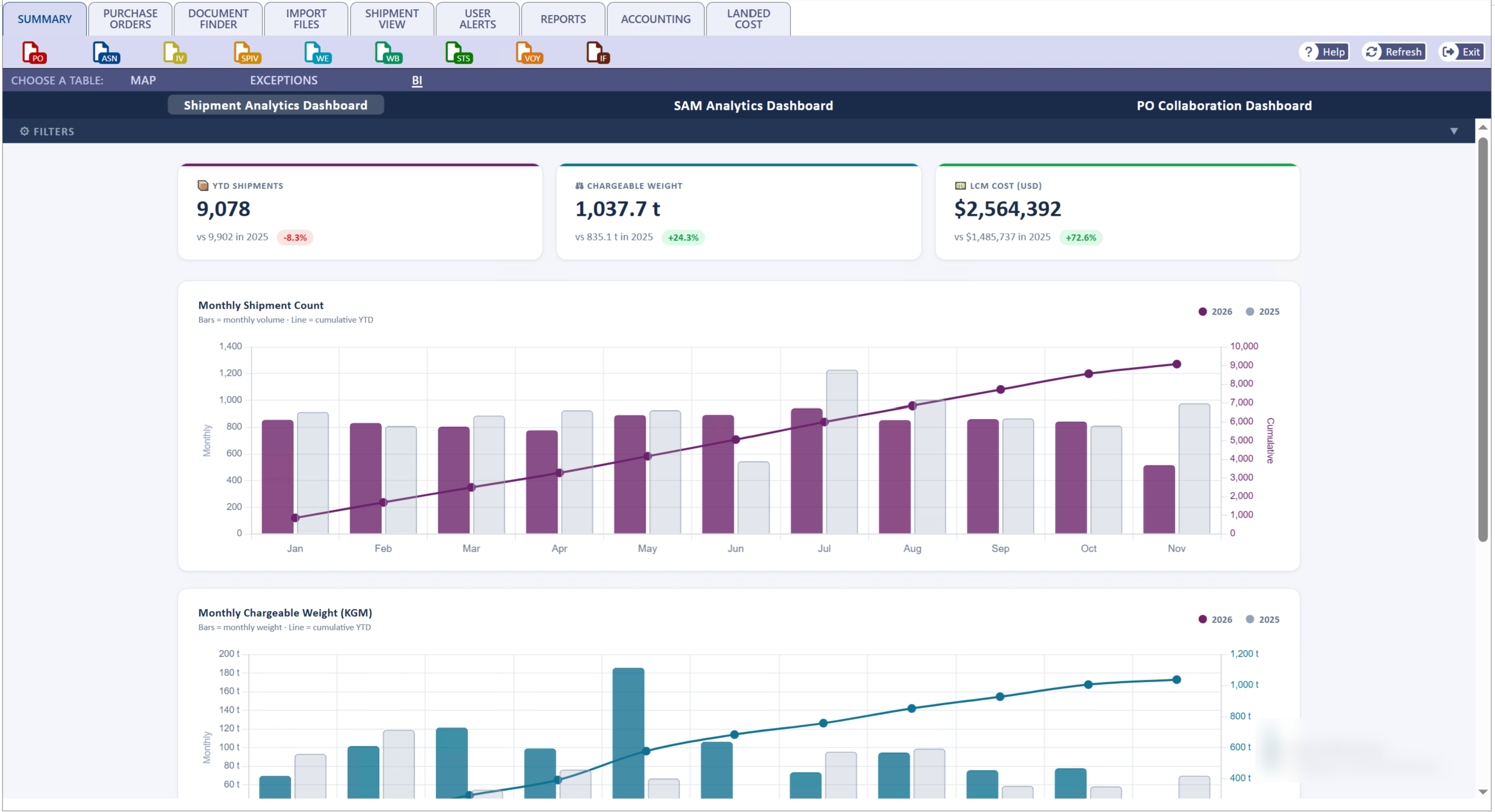
- Analysis built in — pricing, operational and logistics intelligence for the people who have to decide
CompetitivenessWhat it changes
- Less inventory — transparency and control over every order until it reaches the dock
- More productivity — the complex, repetitive work done automatically
- Fewer failures — real-time alerts to the person who can act
- Lower supply-chain cost — comparative data gathered over time, the raw material of supplier negotiation
- Freight under control — the SAM module audits carrier charges, compares history, and reads logistics cost with first-class tools
The values here — traceability, control, electronic archiving, a direct line to carriers and ERP, EDI with suppliers who can meet the standard, financial analysis feeding the organisation's BI — are, for a professional import operation, hard to overstate. The companies that run it — across defence systems, electronics and pharmaceuticals, their names kept on file with us — did not choose lightly.
A thousand seeds, one skin — the whole import file, held as one.
Import is a pomegranate: countless seeds, impossible to count by hand.
The art is to hold them all under a single skin.