
The Bills Nobody Checks
A single shipment can carry ten freight invoices — and at most companies, most of them are never audited. A slice of every one quietly overcharges you. Here's what it costs, and the loop that closes the leak.
There's a line everyone quotes as Einstein — insanity is doing the same thing over and over and expecting a different result — which, for the record, he never actually said. No matter. It is the exact description of how most companies handle their freight invoices: the bills arrive, someone pays them, and nobody ever checks whether the number was right. Month after month, year after year, same result.
Transportation cost is a strange thing — famous and neglected at once. On the right cargo it runs from a fraction of a percent to 10–15% of the value of the goods: a 40-foot container of plastic garden products worth $10,000 can cost $4,000 just to move from Israel to China. For a company selling $50 million a year, the freight budget alone can top a million dollars. That is a budget that deserves to be managed. It almost never is.
The benchmarkBest-in-class, and everyone else
The hard numbers come from the Aberdeen Group, who benchmarked around 170 shippers with transport budgets from half a million to tens of millions of dollars, and sorted them into three tiers: best-in-class, average, and laggard. The gap between the top and bottom is not subtle.
| Freight-audit metric | Laggard | Best-in-class |
|---|---|---|
| Invoices actually audited | 27.1% | 86.4% |
| Carriers complying with contract | 52.2% | 91.9% |
| Days to approve, audit & pay | 12.8 | 9.2 |
| Cost to audit one invoice | $22.02 | $10.98 |
| Year-on-year freight cost | +4.4% | −0.7% |
Read the top row again. At a laggard, barely a quarter of freight invoices are ever checked — and only half the carriers are actually billing to contract. And here is the detail that should keep you up at night: even among the best-in-class, 8.1% of invoices still overcharge. If the top of the class is still being overbilled on one invoice in twelve, what is happening at your company?
Put a cost on it. With about ten invoices per shipment, auditing every one costs a best-in-class shipper roughly $110 a shipment in labour — and double that at a laggard. That is before the overcharges, the undercharges and the duplicate bills you'd actually catch. But the real story is the bottom row of the table: the leaders cut freight cost by 0.7% in a year while the laggards' bill rose 4.4% — a 5.1% swing that has nothing to do with shipping more and everything to do with control.
The size of the leakNine million in sales
Numbers like that sound abstract until you run them through one company. Take a mid-sized importer and follow the money down:
| The leak, one company | Figure |
|---|---|
| Annual sales | $300M |
| Gross margin (~60%) | $180M |
| Operating profit (~7%) | $21M |
| Freight spend (~4% of sales) | $12M |
| Overcharge leak (~5% of freight) | $600K |
| Audit labour (AP · budget · SCM) | $40K |
| Unrealised saving, every year | ≈ $640K |
| Equivalent extra sales (at 7% margin) | ≈ $9.0M |
$640,000 leaking out the bottom every year — the profit on nine million dollars of sales you'll never have to make.
The answerClose the loop
So what do the leaders do that the laggards don't? They stop treating each invoice as a one-off and run the whole thing as a closed loop — a cycle that feeds its own improvement, from negotiating the contract to analysing the data that sharpens the next contract.
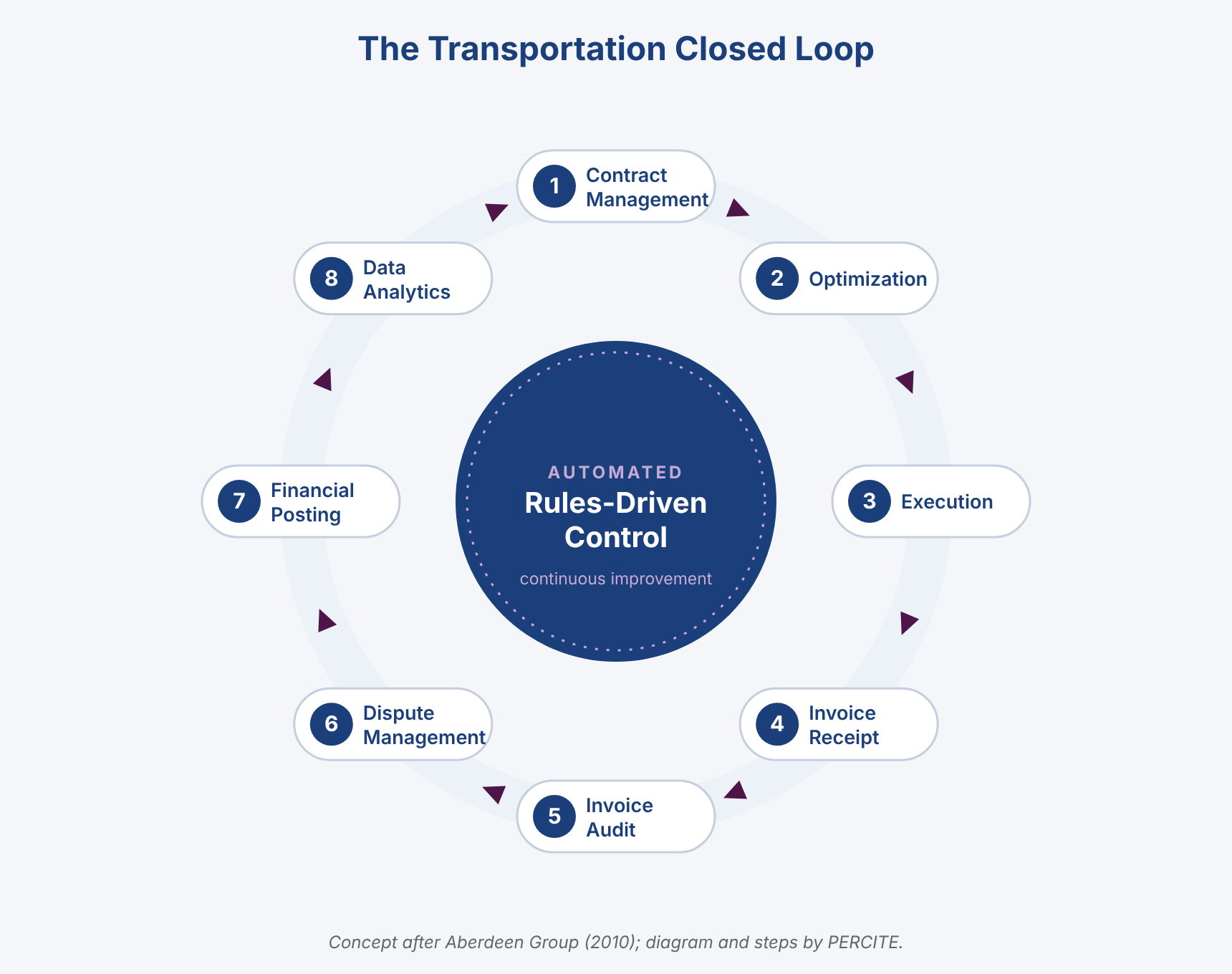
This is precisely what SCMaster's SAM module was built to do — and we push it further than the benchmark does. Catching the overcharge is only half the win; the saving has to land in the books. So the loop also provisions inventory cost before the final invoices arrive, costs and apportions the charges down to the item, and posts the corrected actuals — because a saving that is never recorded is a saving you can't analyse, defend, or repeat.
The gapRun on tools, not heroics
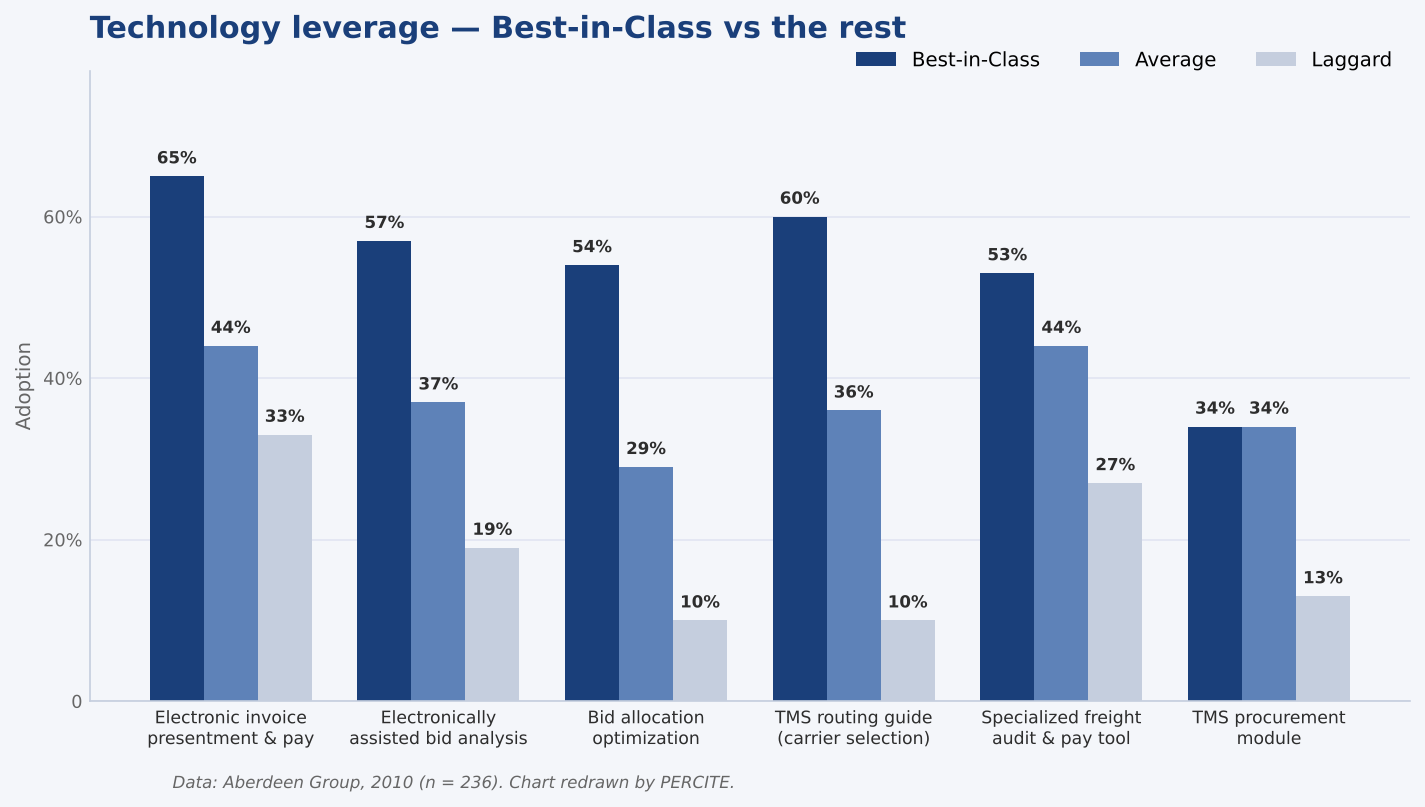
None of this is done by working harder. The same research measured the tools each tier actually runs on, and the distance is stark: the leaders are roughly twice as likely to capture invoices electronically, five times as likely to simulate and compare options, and six times as likely to route shipments online, in the moment.
Where do you stand?The size of the pain
Start with one honest question: how big is the annual transport bill? If you buy CIF and sell EXW, you may genuinely not have this problem — someone else carries it. But if you move 100 containers a year or more, 50 tonnes of airfreight, hundreds of courier shipments, or simply spend more than half a million dollars on transport, the budget is large enough that the bills nobody checks are costing you real money.
A friend — one of the wisest people I know — taught me a Russian saying twenty years ago: he who doesn't take risks doesn't drink champagne. But the real risk here isn't acting. It's the manager who freezes in place, who never shakes up the benchmarks, who stays inside the walls of their own courtyard because what was will be what will be — and who, above all, refuses to learn from what others have already figured out.
“Things have a life of their own,” the gypsy proclaimed. “It's all a matter of waking up their souls.”
— Gabriel García Márquez. In our case, software — but with a soul.
With thanks to the logistics, finance and procurement managers — whose names we keep, gratefully, on file — who let us audit the unaudited, and proved how much was quietly leaking away.