
The Black Hole of the Supply Chain
Between the moment a purchase order is approved and the day the goods reach the dock lies a void no ERP was built to manage — and an expensive, Sisyphean effort to fill it by hand. Here is the case for closing it.
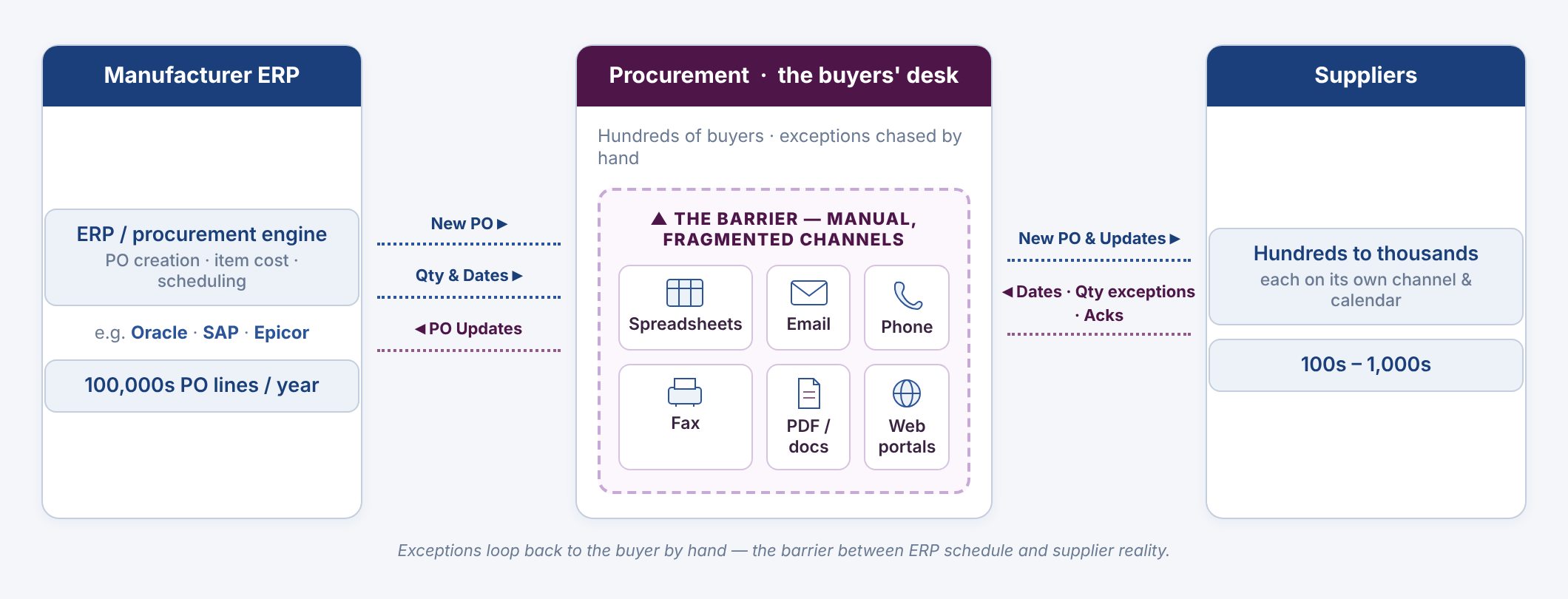
Global manufacturing shifts fast, and supply channels are swapped out as production timing moves. Traditional ERP-based procurement, designed first and foremost for local purchasing, was never built to manage the complexity that follows: suppliers scattered across the world, intricate logistics routes, conditional production, minimum quantities, specialised shipping lanes — parameters the ERP simply does not hold.
From the moment a purchase order is created and approved, through the organisation's chain of sign-offs, until the goods arrive and are received into inventory, an expensive, manpower-heavy effort operates in the gap. We came to call it the black hole of the supply chain — the work that falls between the walls of the ERP.
The price of the voidWhat the gap actually costs
To cover the gap, organisations keep investing in the ERP — bolting on mostly manual processes, agreeing update procedures with suppliers where they can, pulling responses through corporate portals. The effect is to fragment the very thing procurement is meant to be: central, coordinated, controlled. And in our region especially, fast-growing companies acquire other companies running different ERPs — which renders a single corporate portal largely irrelevant for central control.
So buyers and schedulers run an endless pursuit of promised dates across open order lines, re-keying them by hand. Manual updates breed trivial human errors; wrong dates create phantom material requirements, push suppliers to expedite before the goods are needed, and ripple out into cash-flow, handling and storage problems.
For this problem alone, the cost to the organisation reaches roughly 1.5% of COGS:
- 0.50% — excess inventory
- 0.75% — labour and overhead
- 0.25% — production lines idled by supply failures
A system of parts, not one black boxThe paradigm shift
One thing was clear from the start: a single closed solution, stable for all time, is a fantasy. What the problem needs is a system of components, each meeting a few non-negotiable principles:
- The ERP — or the several ERPs across a parent group — does not change
- Ongoing supplier management and support goes down, not up
- Supplier-failure tracking is intelligent and supplier-specific
- Alerts are Advanced Warnings of failures still ahead — not post-mortems of failures already past
- People are redirected from data entry to exception handling
- Every information exchange with suppliers, and back to the ERP, is formal, unified, standard, controlled and open to analysis
- EDI and hybrid-EDI flows fuse through partial automation — without forcing cost or change onto suppliers
- Logistics events feed the procurement picture, easing needless pressure on suppliers and shippers alike
SCMaster SphereThe proposed solution
SCMaster Sphere™ monitors, controls, alerts on and manages procurement and fulfilment — while running the electronic import and export processes alongside. It interfaces with the ERP and lets the organisation share processes electronically with its business partners: suppliers, customers and logistics providers.
An ERP Gateway — a light component, sometimes one that already exists — passes created and updated orders into a single organisational repository: data, lines, items, headers, drawings, versions and all. From there, distribution rules, supplier profiles and logistics templates work out when, to whom and how each delivery should arrive, and send the order to the supplier — in their own language, if wanted. The supplier replies in a simple, fixed, error-proof format, and a response-filtering engine runs quality control on every line: does the promised date match procurement policy; does it sit inside acceptable deviation; does it respect expedite rules?
Above all, the system keeps a formal, central repository of every event in an order's life — versions, cancellations, added lines, quantity and price changes, drawings, even the informal traffic of buyer-to-supplier email. It can be queried; it yields KPIs for supply-chain and procurement managers. None of which is possible while the record of truth lives inside a buyer's Outlook.
Simple for the driver at the wheel — sophisticated under the hood.
A worked example — EMSWhat half a percent is worth
Take an electronics-manufacturing subcontractor (EMS) with $300M in annual sales. These businesses typically import just-in-time, often by air, and run on thin margins — which is exactly what makes the recoverable saving so consequential.
| Metric | Amount | Notes |
|---|---|---|
| Annual sales | $300M | EMS subcontractor |
| COGS | $180M | ~60% of sales |
| Gross profit | $6M–$9M | 2–3% margin |
| Addressable saving | $2.7M | 1.5% of COGS (Aberdeen) |
| Captured at 50% | +$1.25M | deliberately conservative |
| Resulting profit | ~$7.25M | +20% on a $6M base |
A fraction of a percent of COGS, recovered reliably, lifts profit by a fifth. And that is before the value no one can quite put a number to: schedules and margins kept with customers, cash flowing in and out on plan, penalties and delinquencies avoided — and, worst of all when it goes wrong, customers leaving for a competitor.
Forecast · Plan · ActualETA — a simple question with a complex answer
One of the hardest problems in international procurement is deceptively plain: translate a supplier's promised date — say, EXW in Minnesota or Tokyo — into a receipt date in Karmiel that production can actually plan against. A global logistics-time engine, calibrated on real shipping KPIs, does that translation and writes the timeline back to the ERP. Dates are held across three dimensions — Forecast, Plan and Actual — so deviations surface early as Advanced Warnings, while the ERP is updated continuously, without a hand touching it.
The robots and the hands they freeAutomation and the 20%
Rules and automation take over the gentle, error-prone hand-work of procurement; both update the ERP around the clock, lifting enormous pressure off systems and staff alike. Crucially, the system knows what it cannot resolve — and passes only that, around 20% on average, to a buyer.
The scale this reaches is not theoretical. The module has handled over seven million transactions in recent years. Companies running it distribute and receive into their ERPs more than 60,000 orders a year — over 200,000 order lines — across thousands of suppliers, local and international, including drop-shipment scenarios coordinated against carriers who run to real-time schedules.
Packed like a pomegranateThe world of import
Import is packed like a pomegranate with tasks: shippers, airlines and shipping lines, customs brokers and classifications, export and import permits, standards approvals, freight pricing, supplier invoices and import records — an almost infinite body of esoteric knowledge held by a handful of experts who, rightly, feel under-appreciated for how much they move. A telecom-component importer looks nothing like a raw-materials importer, and neither resembles a pharmaceutical or a steel importer supplying military projects, where licensing and batch control are everything.
And then there is the bill. Who audits transportation invoices at a scale of a billion and a half dollars a year — on imports alone? Transportation runs 3–6% of import cost and demands 100% verification: weight, volume, exchange rate, container size, carrier, origin and destination ports, fuel and security surcharges, and a dozen parameters more. No one has the hands, or the hours, to check it all. Which is rather the point.
Quo vadis? We have not yet spoken of the import engine, of logistics events streamed to the ERP line by line, of the EDI thread running through all of it — nor of the Ghost, the robot that watches the world's shipping and sees what can only be seen from there.
All that, and more, in the essays to come.