

The Eagle Has Landed
Every freight, insurance, port, brokerage and duty charge eventually comes to rest on an imported item. Together they can reach a fifth of its value — and most systems can't see them at all. On the supply chain's last frontier.
“Houston, the Eagle has landed.” Neil Armstrong said it from the Sea of Tranquility on 20 July 1969, and it is, by a happy accident of translation, the most exact definition of our subject I know. A landed cost is any cost that lands on a shipment — that settles onto a purchased item as it makes its way from a factory gate somewhere in the world to your inventory ledger. Freight, insurance, the forwarder's handling, port and storage, customs brokerage, duty and tax: each one comes down, like the Eagle, and has to be accounted for the moment the goods touch down and enter stock.
It is, admittedly, a dry subject — dry enough to empty three canteens. But it is also where real money quietly leaks out of a business, and almost no standard system is built to catch it.

The conceptCosts that come down on the item
Indirect costs — salaries, management, marketing, finance — are well known and well managed. Landed costs are the opposite: some are measurable in principle (the freight on a specific import file) and some are known to exist but impossible to pin precisely (the hours the shipping desk spent on one consignment). And the annual “estimate” of logistics cost is a polite fiction — what will the fuel surcharge, the security surcharge and the canal toll be two months from now?
The category is not small. On the right kind of cargo it can reach 20% of a product's value. Picture a twenty-foot container of flat-packed plastic storage units going from Haifa to Houston: roughly $5,000 of freight against perhaps $20,000 of goods — and that is before the leg from Houston to Chicago. In the EMS world — the electronics contract manufacturers who assemble to razor-thin margins — a mere 2% error in cost planning is enough to turn a won project into a loss. The margins there are single digits, and often barely clear five.
We planned on price A — and shipped at price B. And nobody could say, to the shekel, what B actually was.
That is the whole trouble in one line. You quote a customer for a thousand assemblies assuming sea freight; the schedule accelerates; suddenly the components fly. The finance and budget-control people are entirely right to press us — planned budget versus actual landed cost never seems to meet — and so the inventory value is wrong, the product costing is wrong, and the books carry adjustments forever. Worst of all, you can lose on a project and not know it until long after.
The challengeThe Tower of Babel
So we set out to do four honest things: plan the costs on evidence rather than “let's just load 37% and call it a day”; control them (is 1,700 ₪ a reasonable port-storage charge at Ashdod? what was the exchange rate the day the forwarder billed us in shekels?); load them onto the items — not the Excel way; and analyse them, so the next plan is better than the last. That, and nothing less, is what it means to manage.
The first wall you hit is language. Your ERP handles item, supplier, part number, value and currency perfectly well. But which ERP knows what BAF or CAF, War Risk, or Security & Fuel is? Work with two forwarders and each calls the agent's pick-up by a different name; port, bonded-warehouse and ground-handling charges wear different labels on every broker and forwarder invoice. You find yourself climbing stairs that, like Escher's, keep rising and arrive nowhere.

Then comes the question that topples the whole discussion: the allocation model. They tell the cost accountant that ocean freight is charged by volume, or by weight — but if there is no settled unit of measure for every spring and every single length of macaroni, how is the freight ever spread onto the items? Who is going to weigh and measure each box of painkillers (which come in several dosage sizes) or each bag of spaghetti No. 8? Air is worse still: it bills on volume or weight, whichever is greater — a ratio near 1:6, which is emphatically not the divine one —
φ = (1 + √5) / 2 ≈ 1.618…
— so the one elegant formula you hoped for is gone. “Fine,” sighs the accountant, “let's just spread 37% on the item prices.” But: from where did the goods come? Under which INCOTERM? By which mode? What is the duty rate on a car window-frame versus a bumper? And this consignment carried both dutiable and exempt items — and the broker's invoice adds another 102,000 ₪ of duty, levy and VAT, where the VAT is irrelevant to item cost and the rest is not. 37% — come on.
The same part, three waysWhy a single answer is hard
Consider one real request. A purchasing lead — call him A, a former pilot who still pedals uphill on a mountain bike and keeps fifty thousand parts moving for a vehicle importer (the name stays with us) — writes: “Call me, urgent — the Security & Fuel surcharge changed again and it's moving our item prices.” The same component, from a major electronics brand, can be bought three ways, and the landed cost on 100,000 units diverges wildly:
| Source | Terms | Headline price | Not yet in the price |
|---|---|---|---|
| Local agent (IL) | Delivered, duty paid | ~ $150 | Nothing — agent's margin already baked in |
| Korean supplier | EXW | ~ $70 | Courier per kg, customs, brokerage, port, tax |
| German supplier | FOB Frankfurt | ~ €50 | LCL sea via Genoa, lower duty, higher port |
Three prices, three logistics models, three INCOTERMs — and only one of them is the true cost at your own gate. A buyer genuinely cannot say which is cheapest without a model that lands every one of those downstream charges back onto the unit. Half a percent, applied across the purchasing volume of a strategic component, is the difference between a profitable product tree and one the company quietly funds from its own pocket.
The toolboxEight silver bullets
So what would it take to say, with a straight face, that an organisation truly manages its associated costs? Eight capabilities — eight silver bullets, loaded and fired in sequence at a single target. Their power comes from concentration; the oldest military principle is to mass your force at the decisive point, and this is no different.
- Bidding — run requests for freight quotations against service providers, by INCO type and by threshold rules.
- Budgeting — hold a formal plan per logistics supplier and lane, and watch consumption in real time instead of discovering the overrun after the quarter closes.
- Planning — cost a purchase or sale ahead of time, down to the unit, and answer “what if”: earlier but dearer, or slower but cheaper?
- Provisioning — record received inventory at a sound estimate before the carriers' invoices have all arrived.
- Auditing — absorb the freight and service invoices and check them as one transaction against agreement or spot quote, flagging the over- and under-charges.
- Costing — load the associated costs and apportion the duty paid, in logistics and financial cross-sections, down to the individual item.
- Posting — write the costs to the books in proper detail, correcting the provision to the actual as the real numbers land.
- Analysing — read it all back by item, period, source, currency and logistics lane, so the next plan is sharper than this one.
The prize for getting there is not abstract. The value left unrealised through this inefficiency commonly runs to 2–3% of cost of sales — and recovering it can lift gross profit by 8–10%, depending on the vertical. That is not a rounding error. That is the project.
The heart of itCosting, done automatically
Of the eight, one is the heart: costing. It is where the whole chain either lands on the item or doesn't. The job is unglamorous and exact — take every charge on an import file, convert the currencies, and attribute each one to the right units by the right basis: by value, by volume, by weight, by unit count, or as a direct charge — then produce a full, trustworthy per-item cost in seconds rather than over a fortnight of “smoking Excel sheets.”
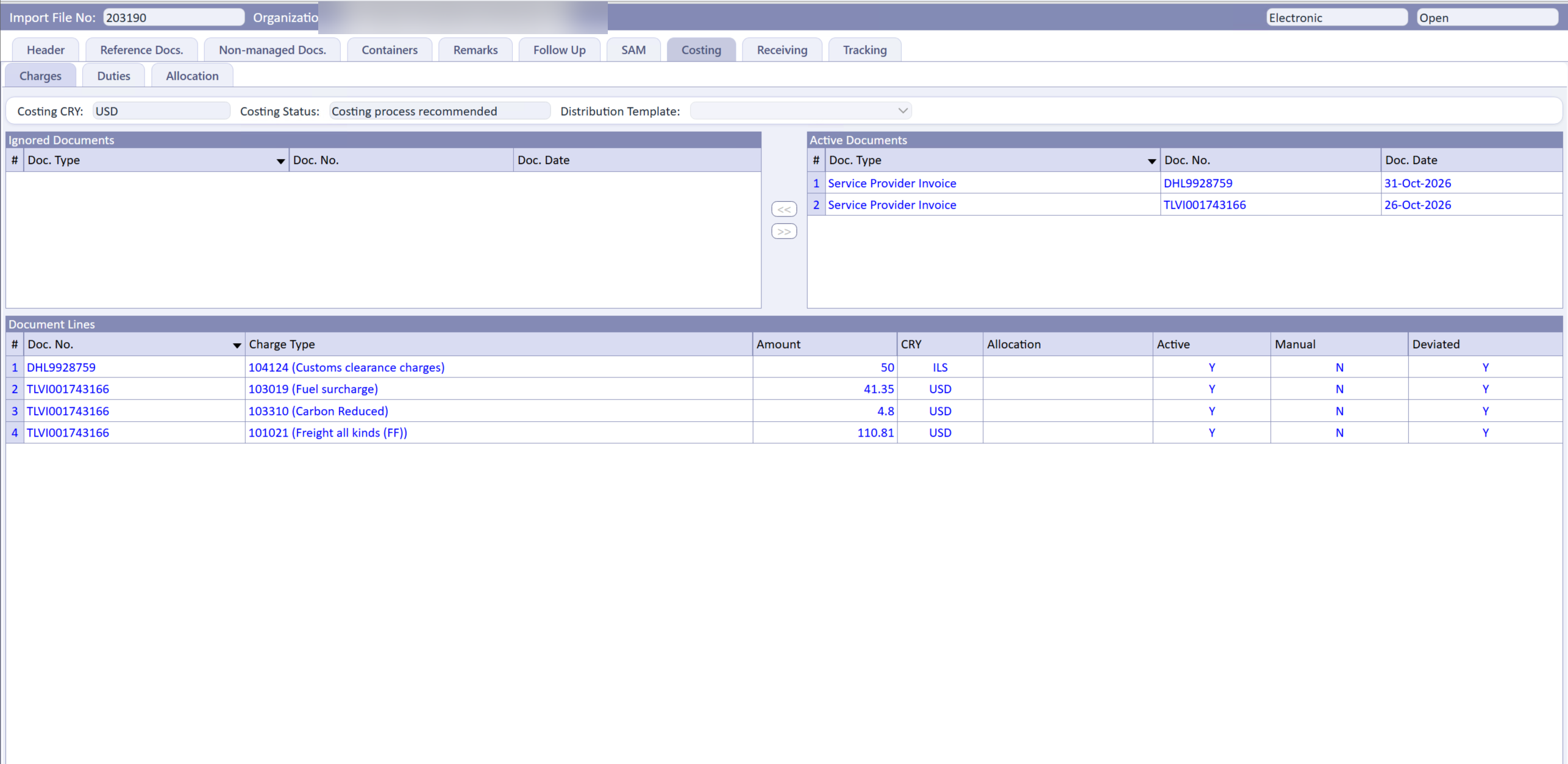
Once the machine does the arithmetic, the strategic questions finally become answerable. Take a twenty-foot container from the United States, ten tonnes of it: around $4,000 by sea — and roughly $66,000 by air, with customs assessed on the CIF value on top. Nobody plans their way between those two numbers on a spreadsheet that has drifted for thirty years and a surcharge that has changed a thousand times.
The whole trade knows the irony: the biggest costs are the ones you can't see on the surface. As the fox tells the Little Prince, what is essential is invisible to the eye — and in landed cost, it is also the most expensive.
The last frontierSisyphus, and the ledger
There is a reason this work reminds everyone who does it of Sisyphus — condemned by Zeus to roll a boulder up the hill, only to watch it roll back down, and roll it again, to the end of his days. The costs are real, they recur on every shipment, and standard ERP leaves them to the delicate, tireless hands of people doing a job that never finishes.

And the spreadsheet is not a safe refuge — it only hides the boulder. The cautionary tale economists still tell is of two Harvard names whose widely-cited austerity paper turned out to rest partly on a stray formula; as one Atlantic writer put it, “the five most terrifying words in the English language are: I can't replicate your results.” If it can happen in a famous economics paper, it can certainly happen in the workbook that quietly sets your inventory value.
The point of building the eight capabilities is not this quarter's number. It is, as a hard-nosed CFO at an automotive group once said of a thing worth doing, to leave something standing “even after all of us leave here” — a stable framework of value that outlasts the people who built it. Landed cost is the last frontier precisely because it is the last place most organisations look. It is also, more often than not, where the margin was hiding all along.
“If the cedars have caught fire, what will the moss on the wall do?”
— Talmud, Moed Katan 25
With thanks to the supply-chain, logistics and finance leaders — at electronics and telecom-equipment makers, a vehicle importer and an automotive group — who pressed these questions on us for years, and whose names we keep, gratefully, on file.