

We Can Hit a Comet
We can fling a probe on a ten-year chase and strike a comet dead-on. Yet nobody can say when the bulk carrier at anchor off Haifa will finish unloading — while the demurrage clock runs at $24 a minute. On the Seven Seas Lions.
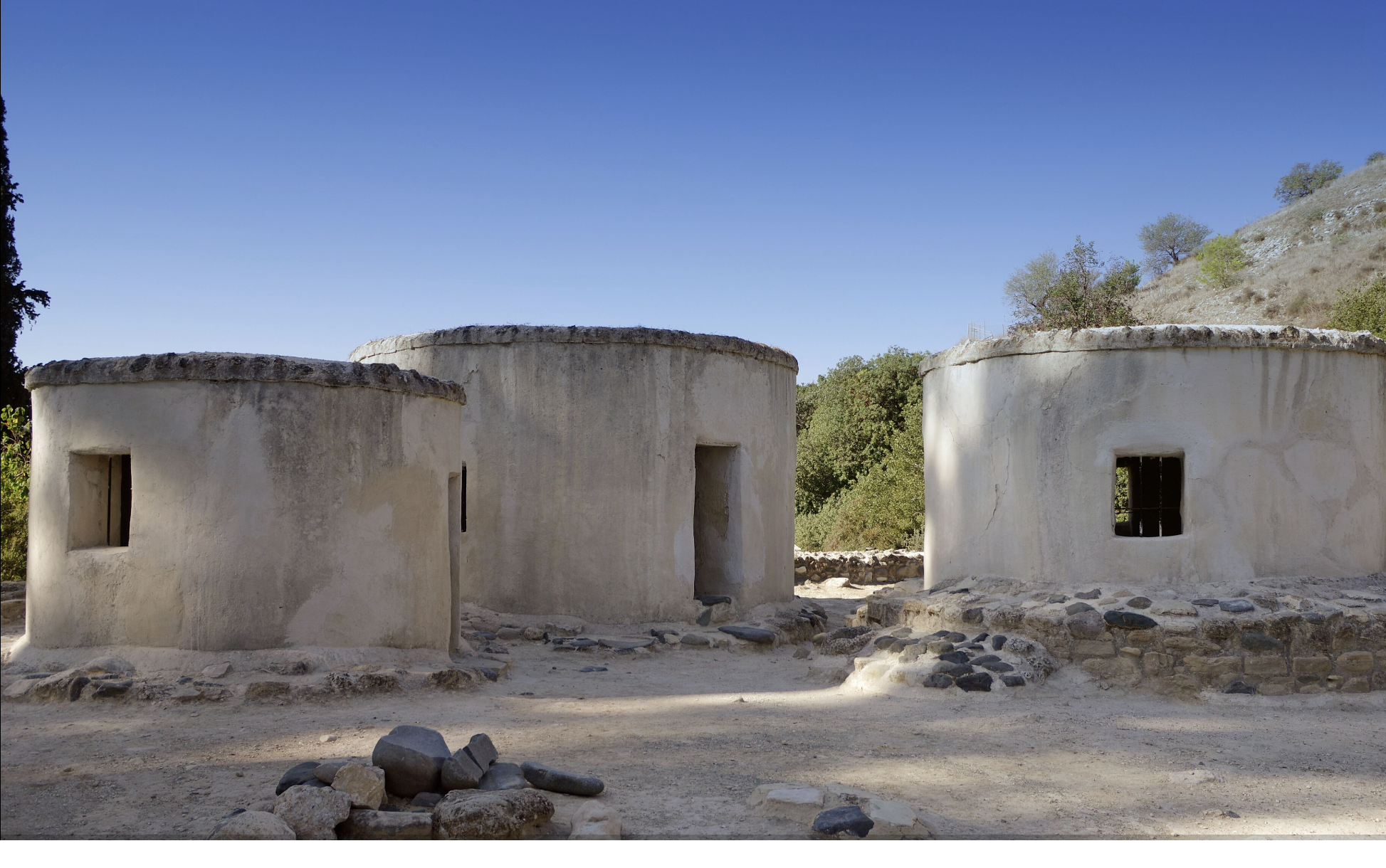
On a steep hill in Cyprus, between Limassol and Nicosia, stand the round stone houses of Khirokitia — a walled settlement some seven thousand years old, old enough that if a city is a place ringed by a wall, this may be the oldest city on earth. Its Neolithic farmers grew wheat and barley and carved bowls from green and grey stone. And they owned ornaments of a mineral not found on Cyprus at all. Someone had carried it across the sea.
That is the thread this whole series has pulled on, and here is where it ends — with the oldest trade of all. Carrying cargo in bulk across water is older than the wheel and far older than any theory of the heavens. The ships changed; the problem never did. Where is the cargo, and when will it arrive?
The LionsTaxis, not buses
Container ships are bus lines — fixed routes, timetables published months ahead. Bulk carriers, the Seven Seas Lions, are taxis. They carry dry bulk — grain, iron ore, coal, limestone, fertiliser, clinker — loose in their holds, and they sail ad hoc, chartered voyage by voyage against demand that lurches with harvests, furnaces and cash. A modest 60,000-tonne carrier holds the equivalent of 1,400 forty-tonne truckloads in a single hull.
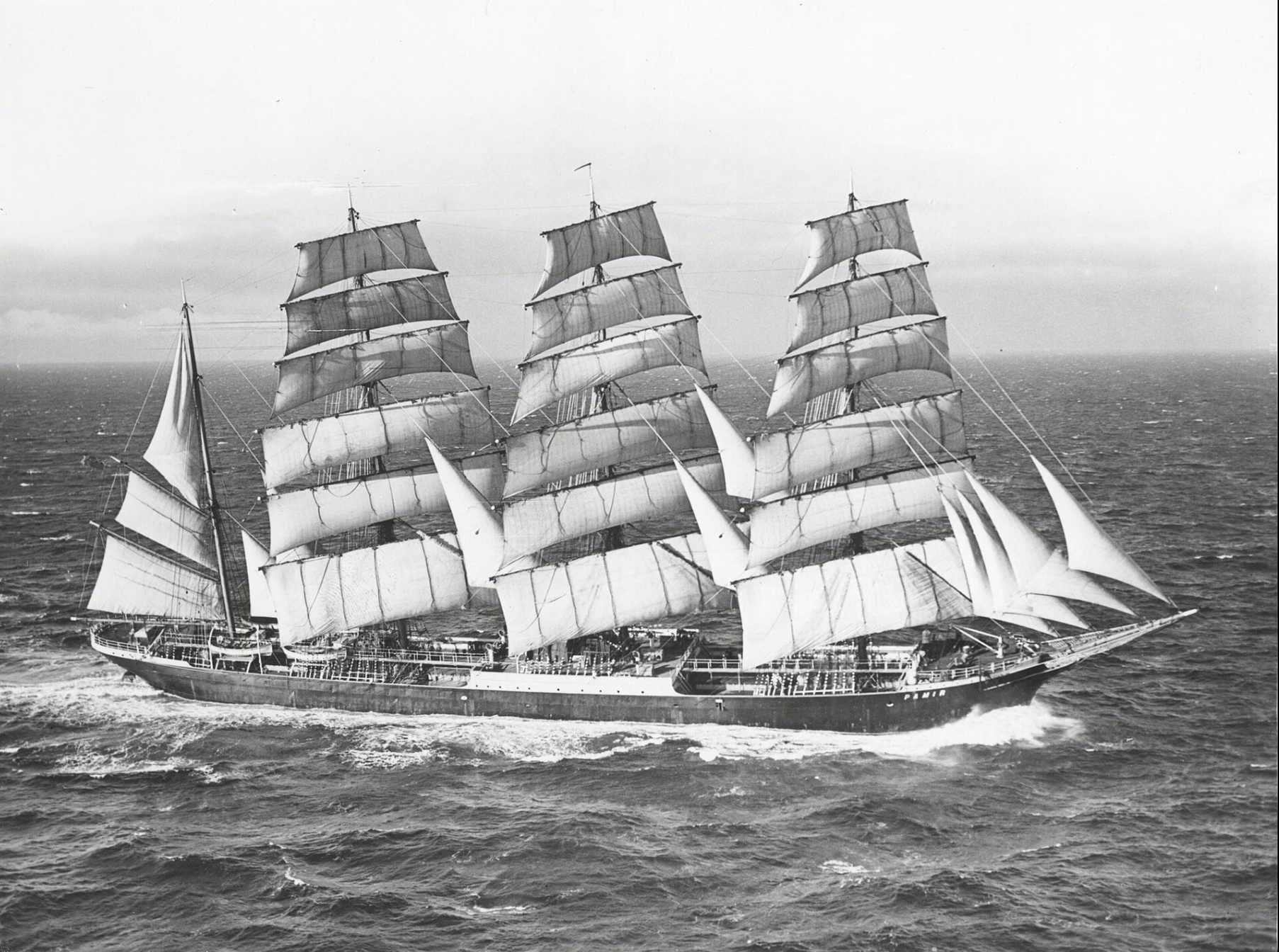
Diesel replaced sail, and the fleet sorted itself by size — by what a canal lock or a port's depth will allow:
| Class | Size (DWT) | Typical cargo / limit |
|---|---|---|
| Handysize | under 38,000 | grains, minor bulks — fits almost any port |
| Handymax / Supramax | 40,000–60,000 | grain, ore, limestone — often its own cranes |
| Panamax | up to ~80,000 | sized to the old Panama locks (beam ≤ 32 m) |
| Capesize | 150,000+ | iron ore, coal — too big for the canals; rounds the Capes |
| Valemax | 380,000–400,000 | iron ore — only a handful of ports can take it |
The moneyMeasured in minutes
Here is what makes this trade merciless: the cost of lost time is measured not in days but in minutes. A charterer who holds a ship past the agreed laytime pays demurrage, and on a big carrier that can run $35,000 a day — about $24 every minute. So the owner sits on a stopwatch: a vessel that doesn't clear its berth at Haifa on time misses its slot at the next port, where another cargo is already waiting. Charter it one of three ways — bareboat (years, the hull alone), time (months), or voyage (a single leg, priced per ton-mile) — and in every case the clock is the enemy.
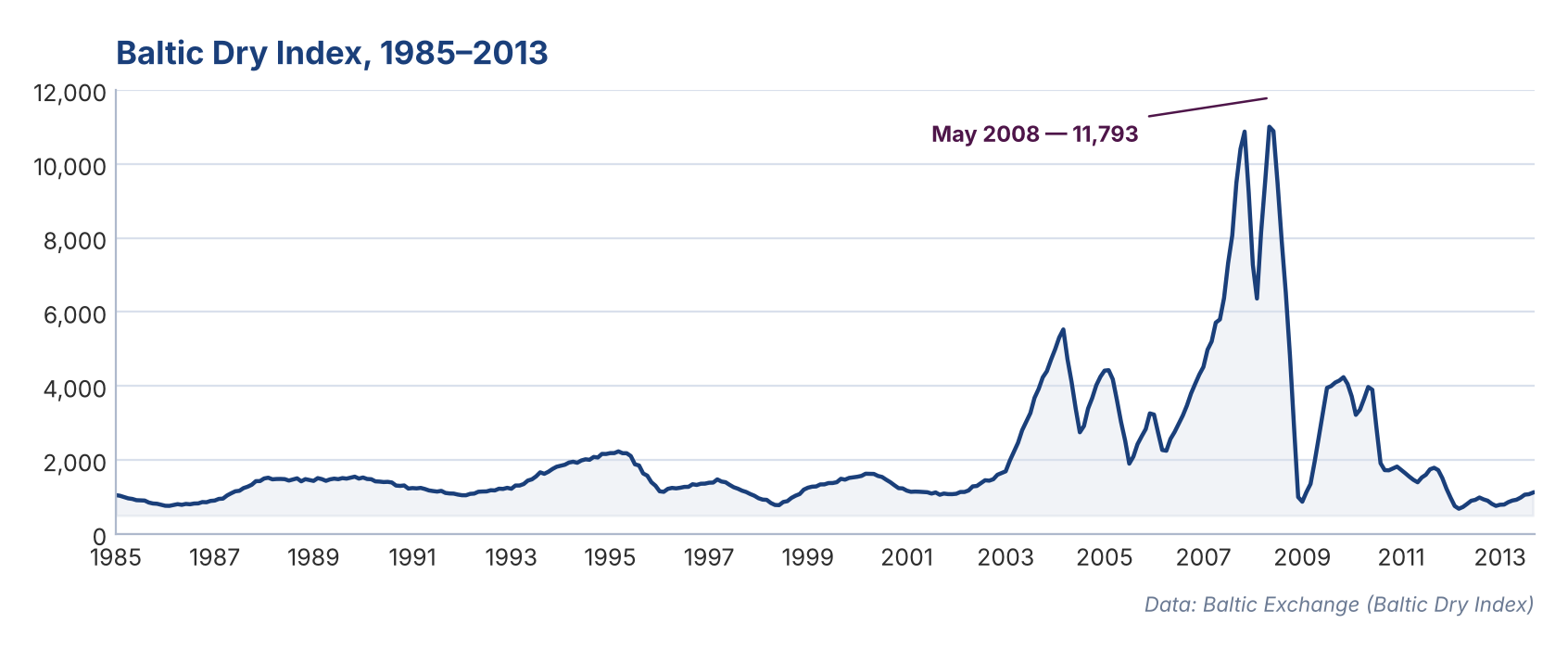
What the clock is worth, day to day, the market sets — and the market heaves. The Baltic Dry Index is its pulse, and it does not beat gently:
The paradoxPrecise in the heavens, blind at the berth
Now raise your eyes. For two thousand years the West held Earth at the centre of creation, Ptolemy's elegant machinery of spheres defended by the Church as settled truth.

Then Copernicus moved the Sun to the centre; Tycho Brahe measured the sky with unheard-of precision; Kepler found the orbits in his numbers; Galileo muttered eppur si muove; and Newton, in the Principia, gave it all one law. After that, humanity could watch a comet, compute where it would be in ten years, and throw a machine across the solar system to meet it there. The European Space Agency did exactly that — Rosetta, launched 2004, chasing comet 67P for a decade and striking its rendezvous dead-on.
We can hit a comet ten years out. We still can't say when the ship will finish unloading.
So why, in heaven's name, can we not predict when a bulk carrier will clear her berth at Haifa and raise anchor within the charter's laytime? The honest answer is that the voyage is easier to model than the dock. The comet obeys gravity. The berth obeys weather, a broken crane, a wildcat stevedore strike, the pace of trucks, the mood of a port — and every hour of it, at $24 a minute, has an owner.
The answerThe tally, and the statement of facts
If you cannot predict it, you must record it — faithfully, minute by minute, in a form everyone will trust. That is the job of the tally company: a neutral witness at the dock, watching the ship around the clock and logging every event, hold by hold, shift by shift, gang by gang — how much came out, how many trucks took it, when work stopped and why.
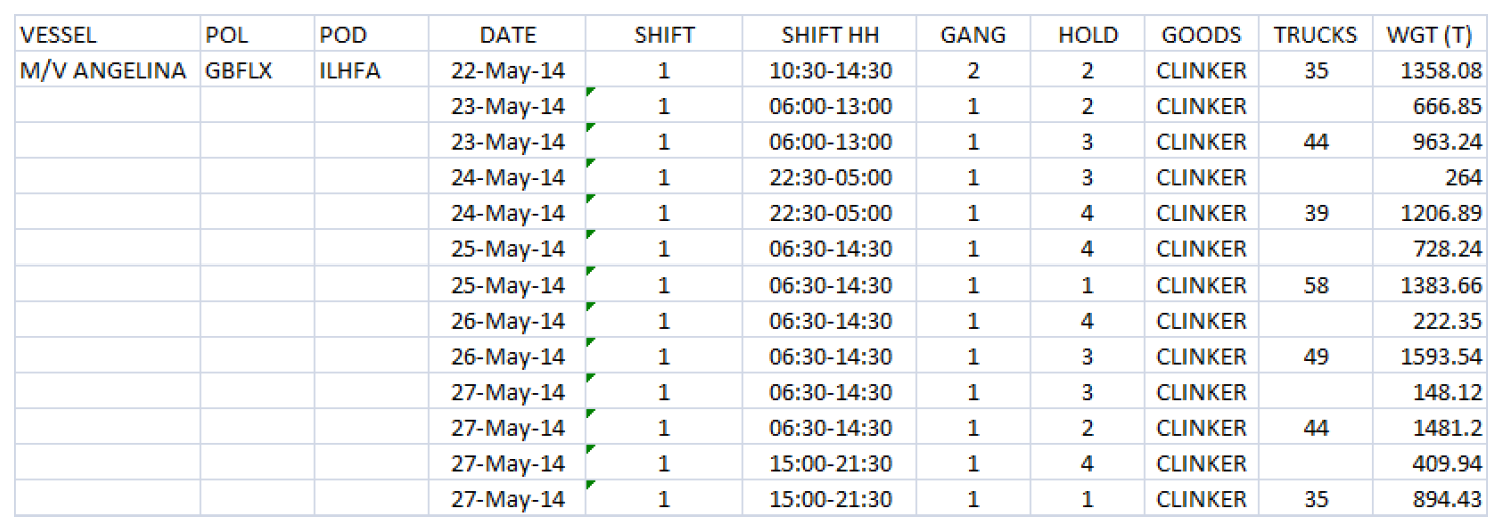
Those lines add up to the Statement of Facts — signed by the tally, and the single legal document by which berth charges and demurrage are finally reckoned, force majeure aside. Done by hand, watching all of it is Sisyphean. Captured as structured events, it becomes something you can actually control: every party sees the same discharge pace in near real time, can judge when the holds will be empty, and can settle the clock without a war of emails between a Turkish agent, a Greek owner and a customer in the United States. The comet we cannot help. The berth, at last, we can.
IthakaThe end of the voyage
And with that, after more than three years, this series reaches its own harbour. We began with a vendor's blind spot and we end seven thousand years deep, among the Lions of the sea — having passed, along the way, through landed cost and EDI, the cloud and the SCOR metrics, the freight audit and the ocean portals. It was never really about software. It was about seeing clearly a world that hides in plain sight. The right poem said it long before I could:
“As you set out for Ithaka, hope your road is a long one,
full of adventure, full of discovery.”
— C. P. Cavafy, Ithaka
With thanks to the owners, agents, charterers and tally crews — whose names we keep, gratefully, on file — who let us watch the Lions at work. And to you, who granted me the privilege of these reflections across more than three years: thank you for the voyage. It was mine as much as yours.