

What Keeps the Scheduler Awake
Two words rob material schedulers, their suppliers, and the finance team of sleep: reschedule-out and ETA. One pushes dates back; the other decides when the goods truly land. Both are murder to control by hand.
Earlier in this series we followed suppliers and orders, the Sisyphean chase for promised dates, the tens of thousands of freight invoices no one can check by eye. This time, two interlocking concepts — the ones that keep schedulers, buyers, MRP and finance tossing at night.
Pushing dates backReschedule-out
Reschedule-out is the instruction, forced by production, customer changes or cash constraints, to delay a supplier's shipment from their site (Ship-From) to yours (Ship-To). It sounds trivial. It is not. After an MRP run — often weekly, especially in electronics, medical and telecom manufacturing — the department is handed thousands of order lines the system wants postponed, and must now make certain every supplier received the change and confirmed it.
Every week. And each line hides a thicket of questions. What if the supplier already sent a promised date — already committed material with its sub-suppliers, down the chain? Does the contract even allow a postponement once a date is promised, and by how much? What if the material has already left the supplier — a fact the ERP cannot know, because nobody tells it the on-board status at line level? You bought EXW; the goods are already yours, in transit, and you look foolish asking to delay them. A million dollars of material that needs to arrive in month Y, not month X, is a cash-flow, interest, storage and customer-dispute problem all at once. The chain is already moving — and like a ship under way, it cannot simply reverse.
What makes it hardThe questions underneath
- Is every change a real change? Does a three-day slip count? A thirty-day one?
- The ERP speaks in NBD (Need-By Date). How do you convert that into an Expected Ex-Works Date at the supplier's ramp?
- How do you tell the carrier to collect on a different day?
- Has a Promise Date already been given — and does the agreement even permit the delay?
- Did the supplier confirm the new promise date — and if you also switched air to sea because there's now time, what's the new Expected Receiving Date?
Too many business rules, too many hands, from too many disciplines. Unsynchronised, they end with material arriving early, wrecking the production plan and the cash plan — and that is before a tired human mistypes 01-07-2021 for 01-07-2012 and the MRP invents a demand that does not exist.
H minusSCMatrix — the countdown
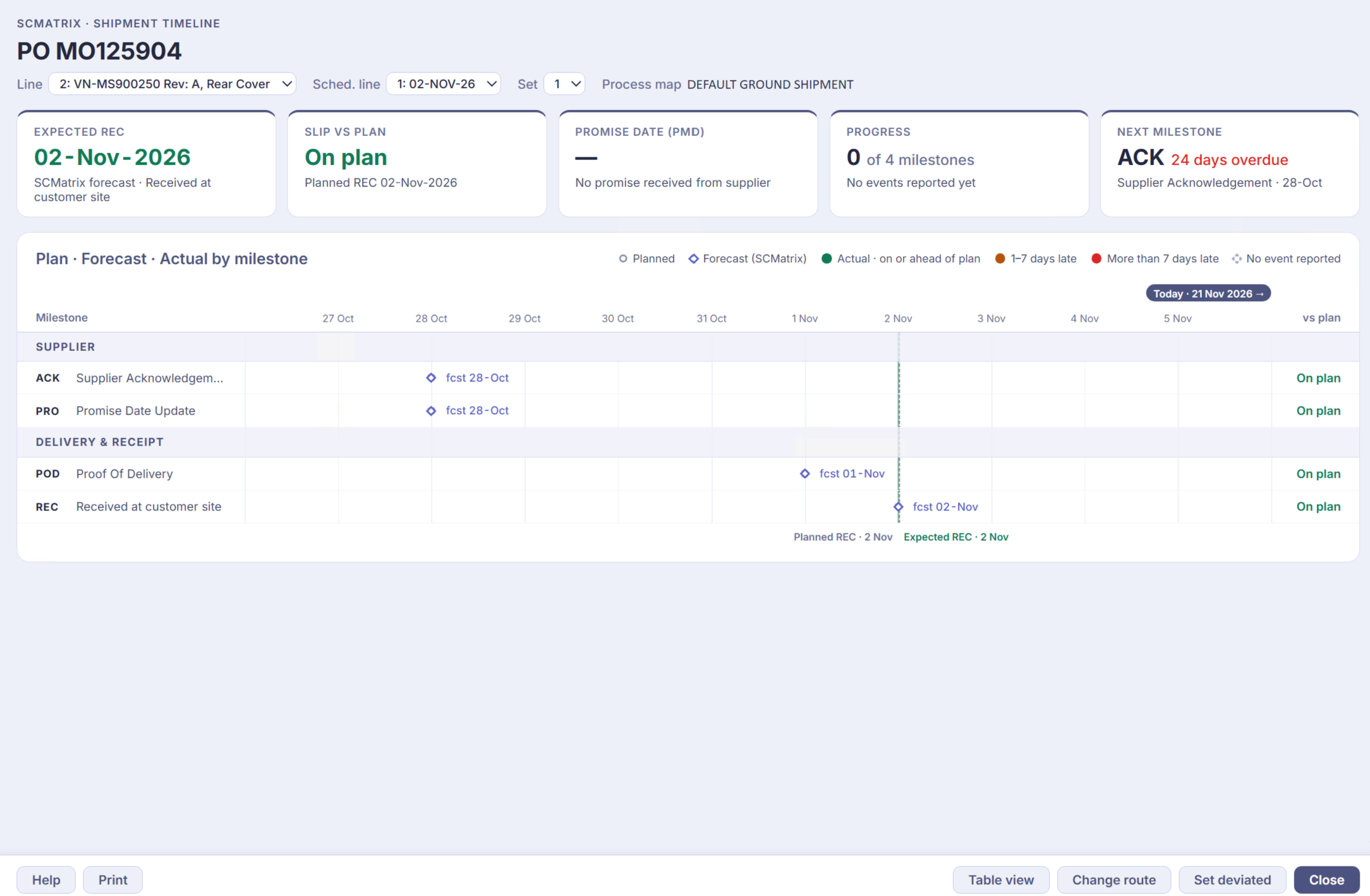
For exactly this, the SCMatrix planning component sits inside the SCMaster PO-collaboration module. It holds a logistics matrix between endpoints worldwide — say, a ramp in Petah Tikva to a supplier's plant in Hungary — with the milestones between them, the standard time for each, and the transport mode. Every order line from the ERP runs against the right matrix, and the algorithm counts backward from the need-by date to the supplier's ramp — the military "H-minus" method. Need-by April 17? The system tells the supplier to be ready by February 20.
From then on, every change from the ERP flows through the same calculation. A postponement recalculates the expected readiness on the Forecast axis; business rules test it — is the change within the agreed range, is it even relevant, has the import module already flagged the shipment as en route and therefore too late? If the supplier doesn't answer within the window, SCMaster raises an exception. The scheduler stops being a cut-and-paste, VLOOKUP, pivot-table clerk for weekly Excel dumps — and starts controlling the process.
When it actually landsAnd ETA?
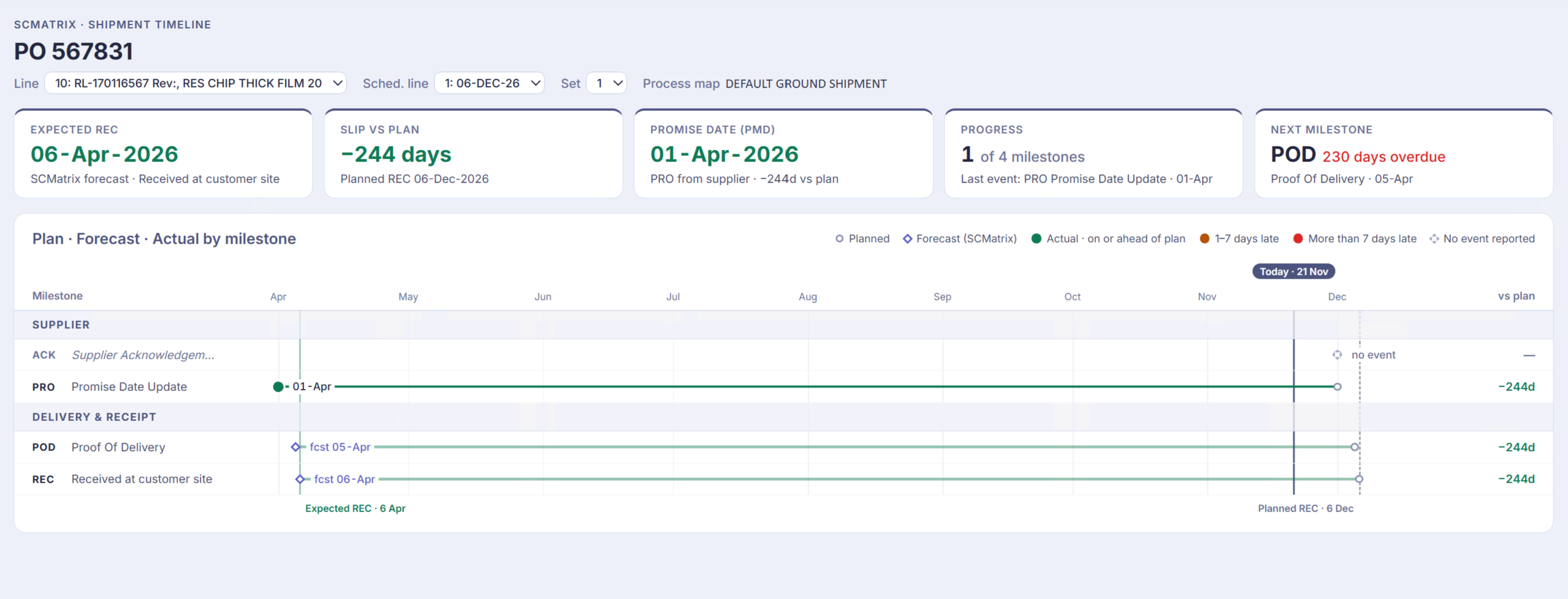
ETA — Expected Time of Arrival — is the word every pilot, skipper and shipper lives by. Here is why it matters even when the supplier keeps its word. Suppose the promise date holds and the goods are ready on time. Everything now hinges on the voyage: on your carrier's space, on whether the cargo makes the planned sailing or the next one a week later. Miss it, and Haifa ETA is no longer April 17 — it's April 30.
SCMatrix's Forecast mechanism listens to that shipping update. From a Haifa ETA of April 30 it moves expected receipt to May 2 — there is still customs, release, the port, and QA in the warehouse, each a milestone in the matrix — and the new Expected Receiving Date flows to the ERP at line level. Then it compares Plan against Actual, and where a gap opens it raises the alert in advance, not after the fact — naming the first milestone where the disruption begins.
“Things have a life of their own — it is simply a matter of waking their souls.”
— Gabriel García Márquez, One Hundred Years of Solitude
In our case the thing is software — but a soul, we think, all the same.
The scheduler used to fight fires at midnight.
Now the countdown runs itself — and the warning comes before the fire.